Antminer S21 Pro vs S21 XP: Which Bitmain Miner Is Worth Buying in 2026?
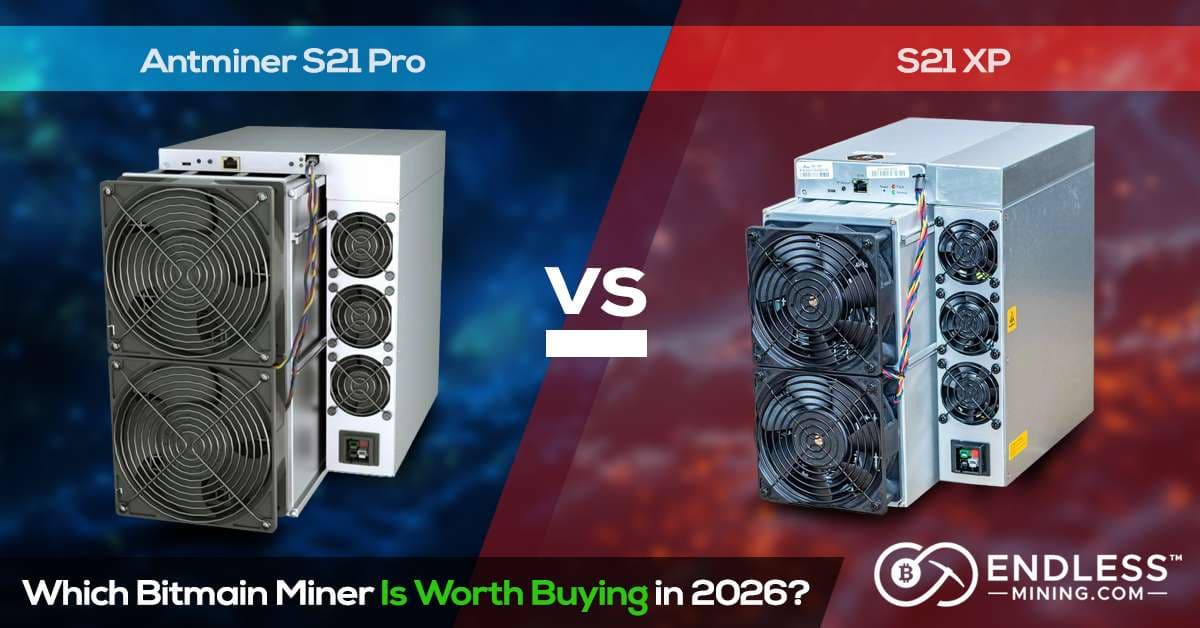
Bitmain Antminer S21 Pro vs S21 XP, which one dominates Bitcoin mining in 2026? Both sit at the top of Bitmain's air-cooled lineup, run on the advanced BM1370 chip, and mine SHA-256 coins more efficiently than any S19-generation hardware.
Which one is worth buying? The answer depends on your electricity rate, budget, infrastructure, and whether you are a home miner or farm operator. This guide covers specs, efficiency analysis, profitability, ROI timelines, and recommendations for each use case.
Where the S21 Pro and S21 XP Fit in the Bitmain Lineup
Bitmain's S21 series represents the current flagship generation of SHA-256 Bitcoin mining hardware, built around the BM1370 chip. The lineup spans from the entry-level T21 to the hydro-cooled S21 XP Hyd at 473 TH/s.
Model
Hashrate
Efficiency
Cooling
Antminer T21
~190 TH/s
~19 J/TH
Air
Antminer S21
200 TH/s
17.5 J/TH
Air
Antminer S21 Pro
234 TH/s
15 J/TH
Air
Antminer S21 XP
270 TH/s
13.5 J/TH
Air
Antminer S21 Hyd
335 TH/s
16 J/TH
Hydro
Antminer S21 XP Hyd
473 TH/s
12 J/TH
Hydro
The S21 Pro and S21 XP occupy the top two spots in Bitmain's air-cooled range. They share the same chip family, physical form factor, and voltage requirements � making them a genuine apples-to-apples comparison for miners deciding where to allocate capital in 2026.
Antminer S21 Pro vs S21 XP: Full Specs Comparison
Specification
Antminer S21 Pro
Antminer S21 XP
Hashrate
234 TH/s
270 TH/s
Power Consumption
3,510 W
3,645 W
Efficiency (J/TH)
15 J/TH
13.5 J/TH
Chip Model
BM1370
BM1370
Chips Per Hashboard
65
91
Total Chips Per Unit
195
273
Algorithm
SHA-256
SHA-256
Noise Level
75 dB
75 dB
Operating Temperature
5�45�C
5�45�C
Input Voltage
200�277 V AC
200�277 V AC
Dimensions
400 � 195 � 290 mm
400 � 195 � 290 mm
Weight
~15 kg
~15 kg
PSU
Integrated
Integrated
Display
None
0.91" OLED
Control Board
Amlogic A113D
Amlogic A113D
Bus Bar Design
PCB traces
Tinned copper
The machines look nearly identical � same size, weight, noise spec, and input voltage. Key differences are chip count per hashboard (65 vs 91), hashrate advantage (36 TH/s more on the XP), and efficiency gain (1.5 J/TH better on the XP). The XP adds a small OLED display showing real-time stats without network access.
BM1370 Chip: The Foundation of Both Machines
Both miners use Bitmain's BM1370 ASIC chip � the company's latest-generation SHA-256 silicon. The BM1370 delivers over 1.2 TH/s per chip, substantially more than the BM1368 (700+ GH/s) in the base S21 and BM1366 (500 GH/s) in S19 XP-series machines.
The difference between S21 Pro and S21 XP comes down to chip density. The XP packs 91 BM1370 chips per hashboard versus 65 on the Pro, driven at optimized frequencies that extract the extra 36 TH/s and 1.5 J/TH efficiency advantage. The XP's tinned copper bus bars replace PCB traces for more stable power delivery.
For context: the S19 XP delivered 140 TH/s at 21.5 J/TH. The S21 Pro more than doubles that hashrate while improving efficiency by over 30%. The BM1370 chip represents a genuine architectural leap.
Efficiency Deep Dive: What J/TH Really Costs You
J/TH efficiency measures electrical energy consumed per unit of hashing power. Lower is always better.
- S21 Pro: 15 J/TH
- S21 XP: 13.5 J/TH
That 1.5 J/TH gap compounds significantly across 24/7 operation.
Annual Electricity Cost Comparison (at $0.07/kWh)
Machine
Power Draw
Annual kWh
Annual Electricity Cost
S21 Pro
3,510 W
30,748 kWh
$2,152
S21 XP
3,645 W
31,930 kWh
$2,235
The XP costs slightly more in raw electricity but produces 36 TH/s more hashrate � mining more Bitcoin for nearly the same energy spend.
Cost Per TH/s Per Year at $0.07/kWh
- S21 Pro: $2,152 � 234 TH/s = $9.20 per TH/s per year
- S21 XP: $2,235 � 270 TH/s = $8.28 per TH/s per year
The XP produces each terahash about 10% more cheaply on an electricity basis. Across a fleet of 50�500 units, that 10% advantage becomes meaningful � and grows more critical as Bitcoin network difficulty rises and margins compress.
The S21 XP's 13.5 J/TH is a 10% improvement over the S21 Pro and 23% better than the base Antminer S21 at 17.5 J/TH. The Whatsminer M60S sits at 18.5 J/TH � considerably behind both. The S21 Pro and S21 XP represent the current efficiency frontier for air-cooled SHA-256 mining hardware in 2026.
Antminer S21 Pro vs S21 XP: Hashrate and Raw Mining Power
- S21 Pro hashrate: 234 TH/s (�3% real-world variance)
- S21 XP hashrate: 270 TH/s (�3% real-world variance)
The XP delivers 15.4% more raw hashrate. In practice, the S21 Pro consistently delivers 230�236 TH/s, while the S21 XP hits 266�274 TH/s. Both perform at or slightly above rated specs under optimal temperatures.
Fleet Density Example: Reaching 10 PH/s
Machine
Units Required
Approximate Total Cost
S21 Pro (234 TH/s)
43 units
~$150,500
S21 XP (270 TH/s)
37 units
~$177,600
Six fewer machines with the XP means simpler rack management and lower cabling complexity. The hardware cost difference narrows when factoring operational overhead savings.
Antminer S21 Pro vs S21 XP: Bitcoin Mining Profitability by Electricity Rate
Bitcoin mining profitability depends on BTC price, network difficulty, and electricity rate. Estimates below use typical April 2026 conditions and BTC price of $70,000�$80,000.
Estimated Daily Net Profit
Electricity Rate
S21 Pro Daily Net
S21 XP Daily Net
$0.04/kWh
~$14.80
~$17.20
$0.06/kWh
~$11.60
~$13.70
$0.07/kWh
~$9.95
~$11.80
$0.08/kWh
~$8.30
~$10.00
$0.10/kWh
~$5.10
~$6.50
$0.12/kWh
~$1.80
~$3.00
$0.14/kWh
~?$1.50
~$0.50
Below $0.08/kWh, both machines generate solid daily profit. The XP's advantage is real but modest for single-machine home miners � roughly $1.50�$2.50/day more than the Pro.
Between $0.10�$0.12/kWh, the XP's efficiency edge matters more. The Pro approaches marginal profitability while the XP retains workable margin.
Above $0.12/kWh, the S21 Pro becomes unprofitable at current conditions. The XP retains a thin margin.
At very cheap electricity ($0.04�$0.06/kWh), both are highly profitable, and the Pro's lower upfront cost maximizes total fleet hashrate on a fixed budget.
ROI and Break-Even Analysis
ASIC miner ROI depends on purchase price, electricity cost, Bitcoin price, and network difficulty trajectory.
Assumed Pricing (Q1�Q2 2026 Market Estimates)
- S21 Pro: $3,000�$3,800 per unit (mid-point ~$3,400)
- S21 XP: $4,200�$5,500 per unit (mid-point ~$4,800)
Break-Even Timeline
Electricity Rate
S21 Pro Break-Even
S21 XP Break-Even
$0.06/kWh
~8.5 months
~10.7 months
$0.07/kWh
~11.4 months
~13.6 months
$0.08/kWh
~13.8 months
~16.0 months
$0.10/kWh
~22.6 months
~24.6 months
At $0.07/kWh and mid-range purchase prices, the S21 Pro breaks even approximately 2 months faster than the S21 XP � despite lower efficiency. The Pro's lower price more than compensates for its efficiency disadvantage in typical home mining scenarios.
The math shifts at higher electricity rates. At $0.10/kWh, both have extended timelines, but the XP's compressed electricity cost per TH gives it proportionally better performance.
Factors That Change the Calculation
- BTC price surge: A sustained move toward $100,000+ materially shortens break-even and tilts the decision toward the XP's premium.
- Rising network difficulty: Increases both machines' break-even timelines. The XP's efficiency advantage becomes more valuable as margins compress.
- Electricity rate changes: A 2�/kWh increase can add 2�4 months to break-even. Lock in your electricity rate before projecting ROI.
- Hardware depreciation: Both machines will lose market value as new generations are introduced.
Antminer S21 Pro vs S21 XP: Hardware Design and Cooling
Both machines share Bitmain's standard S21-series industrial chassis � 400 � 195 � 290 mm, ~15 kg, designed for rack mounting or standalone placement.
Cooling uses high-speed 140mm fans pushing air over aluminum-backed hashboards. The XP's hashboards pack more BM1370 chips per board (91 vs 65), generating more heat per board. Both maintain operational stability within 5�45�C ambient temperature.
The XP introduces hardware refinements for commercial operators:
- Tinned copper bus bars for power delivery instead of PCB traces, improving stability under sustained workloads
- 0.91" OLED display showing real-time hashrate, power draw, and temperature without network connection
- Modular hashboard design allowing individual board isolation and replacement without taking the entire unit offline
Both use the Amlogic A113D control board with an identical firmware interface. Bitmain's stock firmware supports pool configuration, auto-tuning, and temperature management. Third-party firmware, including LuxOS and Braiins OS+ provide more granular control over performance profiles and efficiency tuning.
Noise, Heat Output, and Home Bitcoin Mining Reality
Both miners are rated at 75 dB � roughly equivalent to a vacuum cleaner running continuously. Real-world measurements land between 73�77 dB at one meter. This is not suitable for living rooms or bedrooms without serious noise mitigation. Both require dedicated space � a separate room, garage, basement, or purpose-built enclosure with acoustic treatment.
Heat Output Comparison
Machine
Power Draw
BTU Output Per Hour
S21 Pro
3,510 W
~11,976 BTU/h
S21 XP
3,645 W
~12,437 BTU/h
A standard 1,500W space heater produces ~5,120 BTU/h. Both miners output more than double that amount � continuously, 24/7. In cold climates, this waste heat can be redirected into living spaces, effectively reducing net electricity costs during winter. During warmer months, heat output requires proper exhaust ventilation.
Home mining reality: Both machines are physically identical in noise and heat profile. Neither is beginner-friendly. They need dedicated 240V circuits, active ventilation, and realistic placement planning. Setup costs and complexity are essentially the same for both models.
Antminer S21 Pro vs S21 XP: Setup and Infrastructure Requirements
Before purchasing either machine, verify you can meet all requirements. These apply equally to both models.
Electrical Requirements
- 240V dedicated circuit, minimum 20A breaker per unit (30A recommended for headroom)
- Standard 120V circuits are insufficient and unsafe
- Licensed electrician installation for new 240V circuit typically costs $200�$500 USD
- Clean, stable input power is essential � voltage sags below 200V can cause instability or shutdowns
Networking Requirements
- Standard Ethernet connection to local router (Wi-Fi not supported)
- Mining pool account configured before powering on (Foundry USA, Antpool, F2Pool, Luxor, ViaBTC, etc.)
- Static IP assignment or DHCP reservation recommended for stable remote management
Ventilation and Cooling
- Minimum 6�8 air changes per hour in mining space for safe heat dissipation
- Ambient inlet temperature below 35�C for consistent rated performance
- Exhaust heat must be directed away from inlet � proper front-to-back airflow planning is critical
- Duct shroud adapters can route exhaust heat outside or into adjacent heating spaces
Power Supply Notes
Both machines include integrated PSUs � no external power supply required. Ensure incoming grid power is stable; unstable power is a leading cause of early component failure.
S21 Pro vs S21 XP Price in 2026
Hardware pricing responds quickly to BTC price movements, difficulty changes, and new product announcements. As of Q1�Q2 2026:
- Antminer S21 Pro: Approximately $3,000�$3,800 per unit from major resellers
- Antminer S21 XP: Approximately $4,200�$5,500 per unit from major resellers
The $1,000�$1,800 price gap per unit is the central tension in the S21 Pro vs S21 XP debate. The XP is unambiguously superior technically. Whether that justifies the 30�50% price premium depends on electricity rate and deployment scale.
Price Efficiency Metrics (at mid-range pricing)
Metric
S21 Pro
S21 XP
Price per TH/s
~$14.50
~$17.80
Hardware cost at 10 PH/s fleet
~$150,500
~$177,600
The XP costs approximately $1,000 more per unit to gain 1.5 J/TH efficiency improvement. At scale and higher electricity rates, that efficiency saves meaningful money annually. For a single unit at cheap electricity rates, the payback on that premium is measured in years.
Strategic buyers watch for manufacturer pre-order windows, typically pricing new hardware 15�25% below spot rates.
Who Should Buy the S21 Pro?
The Antminer S21 Pro is the right machine for most miners in 2026. It delivers 90% of the XP's efficiency at a meaningfully lower price and breaks even faster in most scenarios.
? Buy the S21 Pro if:
You have cheap electricity ($0.04�$0.08/kWh)
At these rates, the Pro generates strong daily net profits and breaks even faster due to the lower purchase price. The XP's efficiency premium doesn't pay back quickly enough at cheap electricity rates.
You are a home miner or small-scale operator
The S21 Pro delivers serious Bitcoin mining profitability without the XP's capital outlay. For miners running 1�10 units, the Pro is almost always the smarter financial decision.
Capital efficiency matters more than unit-level efficiency
With the same total budget, you can deploy more S21 Pro units than S21 XP units � more total hashrate, more diversified hardware risk, and faster overall fleet break-even.
You are upgrading from S19-era machines
Moving from an Bitmain Antminer S19j Pro (100 TH/s at 29.5 J/TH) to an S21 Pro more than doubles hashrate while dramatically cutting energy cost per terahash. The upgrade ROI is compelling at any electricity rate below $0.10/kWh.
You want a proven, well-supported machine
The S21 Pro has shipped longer, has wider third-party repair support, and has a larger base of experienced operators documenting real-world performance.
? The S21 Pro is not the right choice if:
- Your electricity rate exceeds $0.10�$0.11/kWh � margins become thin and break-even timelines stretch uncomfortably
- You are building a large commercial farm where rack density, uptime, and marginal efficiency savings compound across many units
- You need modular hashboard replacement capability for commercial uptime management
Who Should Buy the S21 XP?
The Antminer S21 XP is purpose-built for specific operator profiles. Its technical superiority is real � but only financially justified under specific conditions.
? Buy the S21 XP if:
You pay $0.08�$0.12/kWh for electricity
This is where the XP's efficiency advantage translates into meaningfully higher daily net profit. As electricity rate rises, the XP's value proposition strengthens.
You are operating at commercial or industrial scale (20+ units)
Fewer machines needed for the same total hashrate means less rack space, fewer cables, simpler firmware management, and lower maintenance overhead per petahash. At 50+ units, operational savings partially offset the per-unit price premium.
You want the best air-cooled efficiency available without going hydro
If liquid cooling infrastructure is out of scope but you want top-tier efficiency, the S21 XP is the ceiling for air-cooled SHA-256 mining in 2026 at 13.5 J/TH.
You have a long operating horizon (3+ years)
The XP's superior efficiency keeps it profitable longer as network difficulty rises. Operators running machines for 3�5 years benefit substantially from the XP's efficiency durability.
You value the OLED display and advanced hardware design
Real-time stats, tinned copper bus bars, and modular hashboards are meaningful features at scale.
? The S21 XP is not the right choice if:
- You are buying a single unit for home mining at cheap electricity rates � the Pro's faster break-even usually wins
- Budget is limited and you are choosing between one XP or 1.3�1.5� as many Pros � more total hashrate often produces better returns
- You are new to mining and still validating your electricity situation and operational setup
Comparison Against the Competition (Whatsminer M60s/Whatsminer M66S/S21 XP Hyd/S19)
The Antminer S21 Pro vs S21 XP decision exists in a landscape including MicroBT (Whatsminer) and Canaan (Avalon) hardware.
S21 Pro vs Whatsminer M60S
MicroBT's M60S delivers 186 TH/s at 18.5 J/TH � significantly behind the S21 Pro on both hashrate and efficiency. The S21 Pro produces 26% more hashrate at 19% better efficiency, making it the clear winner.
S21 XP vs Whatsminer M66S
MicroBT's M66S presents a more credible challenge to the S21 XP with comparable efficiency. The S21 XP still holds a slight edge in hashrate and efficiency, and Bitmain's deeper service network gives it a reliability advantage for most operators outside China.
Both vs the S21 XP Hyd
If hydro cooling infrastructure is available, the S21 XP Hyd changes the conversation � 473 TH/s at 12 J/TH demands 3-phase 380�415V industrial power and dedicated liquid cooling. For operators without existing hydro capability, the air-cooled S21 Pro and S21 XP remain the practical ceiling.
Both vs S19-Generation Hardware
The case for upgrading from any S19-era machine to either S21 model is strong. The S19 XP (140 TH/s, 21.5 J/TH) delivers nearly half the hashrate at 60% worse efficiency than the S21 XP. Even the S21 Pro significantly outperforms every S19 variant. At any electricity rate below $0.10/kWh, operational cost savings from upgrading compound quickly.
Final Verdict
The Antminer S21 Pro vs S21 XP question has two correct answers � the right one depends on who you are.
For most miners � home operators, small-scale setups, and anyone with electricity under $0.08/kWh � the S21 Pro is the smarter buy in 2026. It delivers 90% of the XP's efficiency at a significantly lower price, breaks even faster in typical home mining scenarios, and generates comparable daily returns in the electricity rate ranges where most individual miners operate. Lower per-unit cost means more total hashrate on a fixed budget � often the more profitable capital allocation.
For commercial and industrial operators � deployments at 20+ units, miners paying $0.08�$0.12/kWh, and operators with long holding horizons � the S21 XP earns its premium. Its best-in-class 13.5 J/TH efficiency, higher hashrate density per rack unit, and superior build features are designed for these environments. The efficiency advantage compounds at scale over multi-year operating periods.
Neither machine is a wrong choice. Both represent the current peak of air-cooled ASIC mining hardware for Bitcoin in 2026 and will remain competitive long after S19-era machines have been pushed offline by rising difficulty. The decision comes down to one thing: run the numbers at your actual electricity rate, use realistic Bitcoin price assumptions, and buy the machine that breaks even fastest within your specific cost structure.
Antminer S21 Pro and S21 XP: Frequently Asked Questions
What is the core difference between the Antminer S21 Pro and S21 XP?
The S21 XP delivers higher hashrate (270 TH/s vs 234 TH/s) and better efficiency (13.5 J/TH vs 15 J/TH) at higher purchase price. Both use the same BM1370 chip. The XP packs more chips per hashboard (91 vs 65) and adds tinned copper bus bars and an OLED display.
Is the S21 XP worth the premium over the S21 Pro in 2026?
It depends on the electricity rate and scale. For home miners with cheap power (under $0.08/kWh), the Pro typically breaks even faster. For commercial operators paying $0.08�$0.12/kWh or running large fleets, the XP's efficiency advantage justifies the premium.
Which machine offers better ROI in 2026?
At current pricing and $0.07/kWh electricity, the S21 Pro reaches break-even in approximately 11�12 months while the S21 XP takes approximately 13�14 months. The Pro's faster break-even makes it the better pure ROI play for most individual miners.
Do both miners use the same chip?
Yes. Both use Bitmain's BM1370 chip. The XP packs more chips per hashboard (91 vs 65) and runs them at higher optimized clock frequencies.
Can both machines run on the same electrical infrastructure?
Yes. Both require 200�277V AC input and dedicated 20A circuit.
Which machine is better for a first-time miner?
The S21 Pro. It delivers serious mining capability at lower capital outlay and breaks even faster.
What does J/TH mean and why does it matter?
J/TH (joules per terahash) measures electrical energy consumed to produce one unit of hashing power. Lower is better. The S21 Pro is rated 15 J/TH; the S21 XP is rated 13.5 J/TH, making the XP approximately 10% more efficient.
How much Bitcoin does each machine mine per day in 2026?
At current network difficulty and BTC price of $70,000�$80,000, the S21 Pro generates approximately $12�$16 gross daily revenue ($9�$11 net at $0.07/kWh). The S21 XP generates approximately $14�$18 gross ($11�$13 net). The XP mines roughly 15% more Bitcoin daily.
What is the real-world hashrate performance?
The S21 Pro consistently delivers 230�236 TH/s. The S21 XP typically delivers 266�274 TH/s. Both generally hit or slightly exceed rated specs under optimal conditions.
Does ambient temperature affect performance?
Yes. Higher ambient temperatures reduce cooling efficiency and can trigger thermal throttling. Keeping the ambient temperature below 35�C is recommended. Above 40�C, expect reduced performance.
Is the S21 XP the most efficient air-cooled Bitcoin miner in 2026?
Yes. The S21 XP at 13.5 J/TH sits at the top of all air-cooled SHA-256 miners in production as of 2026.
How does the S21 Pro's efficiency compare to older S19 hardware?
The S21 Pro at 15 J/TH is dramatically more efficient than any S19-series machine. The S19 XP delivers 21.5 J/TH � 43% worse efficiency.
At what electricity rate does each machine become unprofitable?
The S21 Pro approaches break-even at approximately $0.11�$0.13/kWh. The S21 XP remains profitable up to approximately $0.13�$0.15/kWh. This 2�3 cents/kWh advantage is a primary argument for the XP in higher electricity cost markets.
How much does it cost monthly to run each machine?
The S21 Pro consumes ~2,527 kWh/month. At $0.07/kWh, that's ~$177/month. The S21 XP consumes ~2,624 kWh/month. At $0.07/kWh, that's ~$184/month. The monthly difference is small ($7�$10).
Should I buy multiple S21 Pros instead of one S21 XP?
On a fixed budget (say $10,000), you could deploy 2�3 Pros generating combined hashrate of 468�702 TH/s versus 2 XPs generating 540 TH/s. More total hashrate on a fixed budget often wins at cheap electricity rates.
Does network difficulty affect the machines differently?
Network difficulty reduces Bitcoin mined per day for both proportionally. However, the XP's efficiency advantage means it maintains profitability slightly longer as difficulty rises.
How do pool fees affect profitability?
Most major pools charge 1�2% of mining revenue. At $0.07/kWh and ~$10/day net profit on the S21 Pro, a 1% pool fee reduces daily net by approximately $0.15.
Do I need a separate power supply?
No. Both machines include fully integrated PSUs.
Can I run either machine on 120V household power?
No. Both require 200�277V AC input. Standard 120V circuits are insufficient and unsafe. A dedicated 240V circuit with at least a 20A breaker is required.
How loud are these miners?
Both operate at approximately 75 dB � roughly equivalent to a vacuum cleaner. Real-world measurements land between 73�77 dB at one meter.
What firmware options are available?
Both ship with Bitmain's stock firmware. Third-party options include LuxOS and Braiins OS+, offering advanced auto-tuning and efficiency profiling.
Can I overclock either machine?
Yes, via third-party firmware. Overclocking increases hashrate but raises power consumption and heat output, and can shorten hardware lifespan.
What are the most common failure points?
Fan bearing wear, chip-level faults from thermal cycling, and PSU issues from unstable input power. Regular fan cleaning every 3�6 months and stable 240V power delivery are essential.
Does the S21 XP's modular hashboard design make a practical difference?
For commercial operators, yes. Being able to isolate and replace a single failed hashboard without taking the entire unit offline reduces downtime. For home miners, this feature is less critical.
How do I connect either machine to a mining pool?
Connect via Ethernet, access the miner's web interface through its local IP address, and enter your pool's stratum address, worker name, and password. Both support Stratum V1 and are compatible with all major Bitcoin mining pools.
Will these machines still be competitive in 2027�2028?
Both are built on Bitmain's most advanced air-cooled chip architecture (BM1370) and should remain competitive for several years. Miners with cheap electricity ($0.04�$0.06/kWh) can expect profitability through at least 2027.
Is 2026 a good time to buy either machine?
The post-halving environment has made efficient hardware more important than ever. Both machines represent the practical efficiency ceiling for air-cooled mining today. Treat any purchase as a capital investment with realistic break-even timeline, not guaranteed return.
What is the difference between the air-cooled S21 XP and the S21 XP Hyd?
The air-cooled S21 XP delivers 270 TH/s at 13.5 J/TH using standard 240V power. The S21 XP Hyd achieves 473 TH/s at 12 J/TH but requires 3-phase 380�415V industrial power and dedicated liquid cooling.
Should I wait for the next generation of Bitmain hardware?
"Wait for the next generation" is a perpetual mining dilemma. If the S21 Pro or XP is profitable at your electricity rate today, waiting means forgoing months of mining revenue. Buy when the numbers work for your situation.
Ready to Mine Smarter? Meet EndlessMining.com
If you�re serious about crypto mining, the challenges above � trust, accountability, security, and efficiency � are problems you face every day. That�s exactly why EndlessMining.com was built.
EndlessMining.com is the mining hardware marketplace that actually has your back:
- ? Buy & Sell Mining Hardware � Browse a curated marketplace connecting miners, dealers, and buyers worldwide.
- ? Hosting Services � Skip the overhead. Let EndlessMining host your miners in professional facilities so you can focus on returns.
- ? Mining Consultancy � Get expert guidance on equipment selection, setup, and optimization from people who live and breathe mining.
- ? Mining Calculator � Run the numbers before you commit. Estimate profitability based on your hardware, power costs, and current network conditions.
- ? Escrow-Protected Transactions � EndlessMining.com is currently the only crypto miner marketplace officially partnered with Escrow.com, meaning every transaction is protected. No scams. No chargebacks. No uncertainty. In a space defined by trustlessness, Endlessmining.com offers something rare: accountability you can count on.