Bitmain Antminer S21 vs WhatsMiner M60: Which Should You Buy?
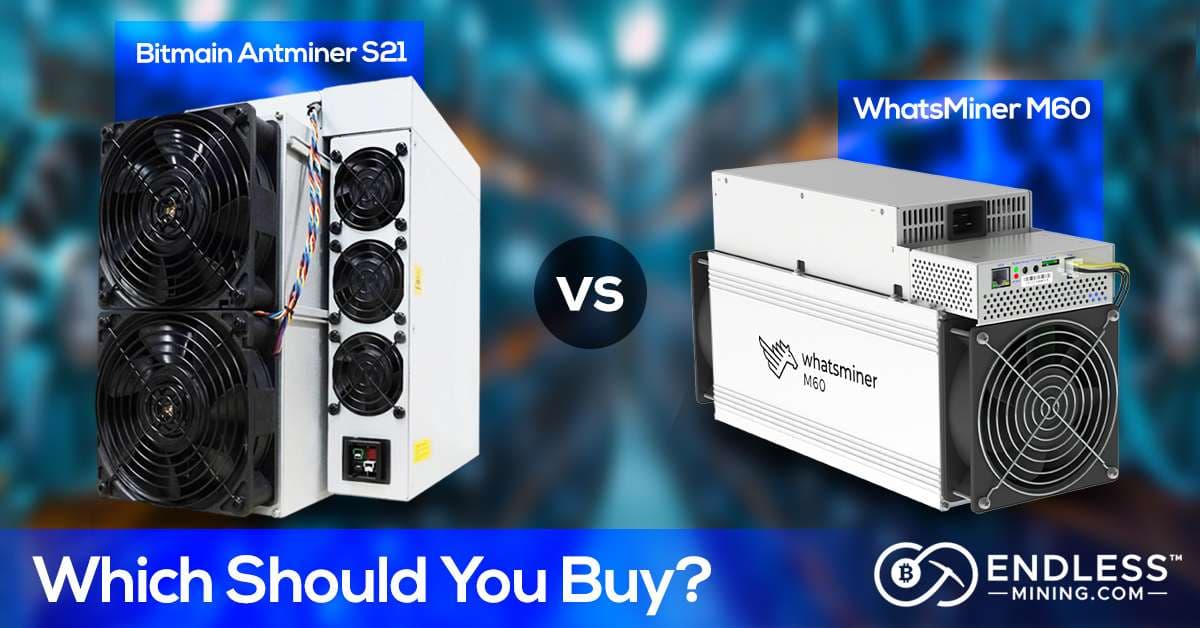
If you're serious about Bitcoin mining, the Bitmain Antminer S21 vs WhatsMiner M60 resemblance will definitely get your attention. Both represent the cutting edge of SHA-256 ASIC technology, both promise industry-leading efficiency, and both carry price tags that demand careful consideration before you commit. Choosing the wrong miner for your specific operation can mean the difference between healthy margins and a machine that barely covers its electricity bill.
This in-depth guide breaks down every metric that matters � hashrate, power efficiency, build quality, noise, thermal management, software, support, and total cost of ownership � so you can make a fully informed decision. Whether you're running a single unit at home or scaling up a commercial facility, understanding the Bitmain Antminer S21 vs WhatsMiner M60 rivalry is essential before you spend your capital.
A Quick Look at Both Manufacturers
Bitmain has dominated the ASIC mining hardware market since the early 2010s. Headquartered in Beijing, the company holds the largest global market share for Bitcoin mining equipment and operates its own semiconductor fabrication partnerships, primarily with TSMC. The Antminer S-series has been the flagship product line for years, and the S21 is the latest evolution in that lineage.
MicroBT entered the scene as a serious challenger around 2018 when its WhatsMiner M-series rapidly gained a reputation for reliability and competitive performance. Founded by former Bitmain engineers, the company has carved out a substantial share of the enterprise mining market, particularly among large-scale operations in North America and Europe. The M60 series represents MicroBT's most advanced generation to date.
Core Specifications: Side-by-Side Comparison
Before diving into the nuanced analysis, it helps to lay the raw numbers on the table.
Specification
Bitmain Antminer S21
MicroBT WhatsMiner M60
Hashrate
200 TH/s
186 TH/s
Power Consumption
3,500 W
3,441 W
Efficiency
17.5 J/TH
18.5 J/TH
Chip Process
5nm (TSMC)
5nm (Samsung)
Cooling Type
Air-cooled
Air-cooled
Noise Level
~75 dB
~75 dB
Operating Temp
0�C � 40�C
0�C � 35�C
Dimensions (mm)
400 � 195 � 290
370 � 195 � 290
Weight
14 kg
14.9 kg
Ethernet
10/100M
10/100M
Warranty
180 days
365 days
Note: Specifications may vary by firmware version and operating conditions.
Hashrate Performance
When it comes to raw computational power, the Antminer S21 holds a measurable lead. At 200 TH/s under standard operating conditions, it outpaces the WhatsMiner M60's 186 TH/s by roughly 7.5%. In isolation, that difference might not seem dramatic, but when you're running dozens or hundreds of units, those extra terahashes compound into meaningful additional revenue over time.
That said, MicroBT has released variants of the M60 series � including the M60S and M60S+ � that push hashrates higher, some reaching up to 240 TH/s in their highest-performance configurations. If you're comparing flagship models at their base specifications, the Antminer S21 wins on raw throughput. However, if you're willing to step up to a higher-tier M60 variant, MicroBT can match or exceed the S21's output.
It's also worth noting that both machines can be overclocked via third-party firmware such as BraiinsOS+ or vnish, which can squeeze additional performance out of either unit. The S21's headroom for overclocking has been reported to be somewhat more conservative than previous Antminer generations, while the M60 responds well to modest tuning.
Power Efficiency: The Metric That Matters Most
In the modern Bitcoin mining landscape, efficiency � measured in joules per terahash (J/TH) � is arguably more important than raw hashrate. Your electricity cost is your largest ongoing expense, and a more efficient miner puts more of each mined satoshi into your pocket rather than your utility bill.
The Antminer S21 achieves approximately 17.5 J/TH, which currently places it among the most efficient air-cooled miners available. The WhatsMiner M60 comes in at around 18.5 J/TH � still extremely competitive by industry standards, but trailing the S21 by roughly 5.7%.
To put this into practical terms: if you're paying $0.07 per kWh (a competitive rate for many mining operations), the S21 costs approximately $0.245 per hour to run, while the M60 costs roughly $0.241. The difference per unit is minor, but efficiency gaps become significant at scale. A 100-unit farm running 24/7 for a year at those rates would see the S21 come out ahead in electricity savings, though the margin is modest enough that other factors � purchase price, reliability, warranty � can easily tip the overall economics the other way.
The Bitmain Antminer S21 vs WhatsMiner M60 Efficiency Deep Dive
One of the most critical questions for any mining investor when comparing the Bitmain Antminer S21 vs WhatsMiner M60 is: how does the efficiency hold up under real-world conditions, not just manufacturer specifications?
The Antminer S21 uses Bitmain's proprietary 5nm chips built on TSMC's process node. TSMC's 5nm has a proven track record for consistency, and Bitmain's in-house chip design team has optimized the architecture aggressively for Bitcoin's SHA-256 workload. The result is a machine that tends to perform close to its rated specifications when ambient temperatures are controlled.
The WhatsMiner M60 relies on Samsung's 5nm node. Samsung's process has historically shown slightly higher power leakage in high-temperature environments, which can push real-world efficiency slightly below the spec sheet in hot climates or poorly ventilated facilities. MicroBT partially offsets this through advanced power supply design � the M60 uses an integrated PSU with sophisticated voltage regulation that helps maintain consistent efficiency across a broader range of grid quality conditions.
For miners in regions with unstable power or significant temperature variation, the M60's more robust power delivery system can be a genuine advantage. For miners operating in stable, cool environments, the S21's efficiency edge is more likely to show up in practice.
Thermal Management and Cooling
Both the Antminer S21 and WhatsMiner M60 are air-cooled units that rely on high-speed fans to push air across their hashboards. Neither requires external liquid cooling infrastructure out of the box, which is an important consideration for operations that want to minimize setup complexity and capital expenditure.
The Antminer S21 runs with four high-speed fans and manages heat across a single hashboard design that Bitmain has refined over multiple product generations. The airflow path is well-optimized, and the machine tends to maintain its rated performance consistently as long as intake air temperature stays below 40�C.
The WhatsMiner M60's thermal operating window is slightly tighter, with a maximum recommended ambient temperature of 35�C. In practice, this means M60 operators in hot climates need to invest a bit more in cooling infrastructure � additional HVAC capacity, better ventilation, or strategic placement within a facility � to keep units in their optimal operating zone. Fail to do so, and the machine will throttle its hashrate to protect itself, undermining the efficiency and performance numbers you paid for.
For immersion cooling enthusiasts, both manufacturers have released immersion-ready variants. Bitmain offers the Antminer S21 Hydro, while MicroBT has the M60S Hydro. These liquid-cooled versions deliver significantly higher hashrates (up to 335 TH/s for the S21 Hydro) and are worth considering for large-scale operations that have already invested in immersion infrastructure. However, for the standard air-cooled comparison that most buyers are evaluating, the S21's slightly wider thermal tolerance gives it a minor edge in deployment flexibility.
Bitmain Antminer S21 vs WhatsMiner M60: Build Quality and Hardware Reliability
Reliability is a dimension that raw specs don't capture but that directly affects your bottom line. A miner that runs at 95% uptime is worth more than a theoretically faster unit that fails frequently.
Bitmain's Antminer S series has a well-documented reliability record stretching back years. The S21 benefits from an evolved hardware platform and uses Bitmain's proven APW series power supplies. Hashboard failures, while not unheard of, are generally manageable within the warranty period, and Bitmain's repair infrastructure is the most extensive in the industry. That said, Bitmain's 180-day warranty on the S21 is relatively short � a notable drawback for buyers expecting multi-year hardware lifespans.
MicroBT's build quality has impressed many large-scale operators. The WhatsMiner M60 feels mechanically solid, with a well-constructed chassis that holds up in demanding data center environments. More significantly, MicroBT offers a 365-day warranty on the M60 � double what Bitmain provides � which represents real financial protection on a multi-thousand-dollar purchase. MicroBT has also invested heavily in its after-sales service network in North America and Europe, making warranty claims more accessible for Western buyers than they once were.
Several large mining operations that have run both brands side by side report that MicroBT units have shown slightly better long-term reliability in terms of hashboard durability, though Bitmain has closed the gap considerably with the S21 generation. Independent data is limited, and individual experiences vary significantly based on deployment conditions.
Software, Firmware, and Mining Pool Compatibility
Both machines ship with manufacturer firmware that supports standard Stratum and Stratum V2 protocol connections, making them compatible with every major mining pool, including Foundry USA, Antpool, F2Pool, ViaBTC, Binance Pool, and Luxor.
Bitmain's web-based management interface (Antminer's built-in dashboard) is familiar to anyone who has operated previous Antminer generations. It's functional and straightforward, offering hashrate monitoring, fan speed control, pool configuration, and basic diagnostics. The interface hasn't changed dramatically over the years � which is either a comfort or a frustration depending on how you feel about Bitmain's design evolution (or lack thereof).
MicroBT's management interface for the M60 is similarly utilitarian, with comparable functionality. Some operators find it slightly easier to navigate for first-time setup, but the day-to-day experience is broadly similar between the two.
Where the software picture gets more interesting is third-party firmware. BraiinsOS+ has official support for the Antminer S21, bringing improved autotuning, per-chip performance optimization, detailed telemetry, and a fee-based efficiency improvement that can push the S21's real-world performance meaningfully beyond stock firmware. VNish firmware is another popular option for the S21. The M60 has less mature third-party firmware support at the time of writing, though BraiinsOS+ support for MicroBT hardware has been expanding.
For operators running large fleets, both Bitmain (via its Antminer Remote Dashboard) and MicroBT (via WhatsMiner Device Management) offer centralized management tools. Bitmain's fleet management tooling has historically been more developed, though MicroBT has been investing in this area.
Noise Levels and Home Mining Considerations
Both machines are rated at approximately 75 dB under load � roughly equivalent to a busy restaurant or a loud vacuum cleaner running continuously. Neither is remotely suitable for a bedroom, living room, or any space where people work or sleep nearby without significant soundproofing.
For dedicated garage setups, purpose-built mining sheds, or commercial facilities, 75 dB is standard and manageable with appropriate ear protection during maintenance visits. For anyone hoping to mine at home in a shared living space, both machines will create friction with family members and potentially with neighbors depending on wall and floor construction.
The noise profiles between the two machines are broadly similar. Some users report that the Antminer S21's fan tone is slightly more high-pitched and penetrating than the M60's deeper drone, but this is subjective and varies between individual units. If noise is a deciding factor in your setup, hands-on testing in your specific space is the only reliable way to evaluate it.
Price, Availability, and Total Cost of Ownership
Hardware prices in the ASIC mining market fluctuate substantially with Bitcoin's price and network difficulty. As a general reference point, both the Antminer S21 and WhatsMiner M60 have traded in a broadly similar price range � typically between $2,500 and $5,000 per unit depending on market conditions, vendor, and whether you're buying directly from the manufacturer or on the secondary market.
Bitmain sells the Antminer S21 through its official website and through a global network of authorized resellers. Inventory availability from Bitmain directly has historically been constrained during bull markets, leading buyers to pay premiums on secondary platforms. MicroBT sells through its website and through authorized distributors, including several major North American resellers that carry consistent inventory.
For total cost of ownership (TCO) analysis, the key variables are:
- Purchase price (one-time)
- Electricity cost (ongoing � the dominant cost factor)
- Facility costs (rack space, cooling infrastructure, internet)
- Maintenance and repair (more significant with shorter warranties)
- Resale value (both brands hold value reasonably well; Bitmain's brand recognition can help on resale)
The S21's efficiency advantage slightly reduces electricity cost per TH/s compared to the M60. However, the M60's double warranty length reduces your expected repair and replacement expenditure over the first year. Depending on your electricity rate and whether you experience hardware failures, the TCO difference between the two machines over a 12-month period may be quite small.
Who Should Buy the Bitmain Antminer S21?
The Antminer S21 is the stronger choice in specific situations. If you prioritize raw efficiency above all else and operate in a cool, well-controlled environment where ambient temperature consistently stays below 35�C, the S21's 17.5 J/TH spec will generate slightly better margins on every kWh you spend. It's also the better choice if you already have Bitmain infrastructure and are familiar with Antminer firmware and management tools � operational continuity has real value in large fleets.
The S21 is also a stronger candidate if you intend to use third-party firmware like BraiinsOS+, which has mature, well-tested S21 support. Advanced firmware users can extract meaningful additional performance from the S21 with precise per-chip autotuning.
For buyers who want the absolute highest hashrate per unit without stepping into immersion cooling, the standard Antminer S21 at 200 TH/s currently has an edge over the base M60 configuration, making it slightly more capital-efficient when measured in hashrate per dollar invested.
Who Should Buy the WhatsMiner M60?
The WhatsMiner M60 makes more sense in several important scenarios. Its 365-day warranty � twice Bitmain's offering � provides meaningful financial protection on a hardware investment that costs several thousand dollars per unit. For buyers who are deploying capital carefully and want to minimize first-year risk, this warranty advantage is not trivial.
The M60's integrated PSU design also makes it more resilient to power quality issues. If your facility experiences fluctuating grid voltage, occasional surges, or you're operating in a region with less reliable infrastructure, the M60's power delivery architecture handles variability better than the S21's external PSU approach.
Operators in warmer climates should look carefully at the M60's 35�C max ambient spec versus the S21's 40�C � but MicroBT does offer immersion and hydro variants for extreme environments. For standard air-cooled deployment in moderate climates, both are viable. The M60's slightly higher J/TH rating is largely inconsequential in the broader TCO picture when weighed against its reliability advantages.
Large-scale operators who have built relationships with MicroBT's enterprise sales team also report stronger account management and faster support response times compared to Bitmain's more transactional customer service experience, particularly for Western-based operations.
Bitmain Antminer S21 vs WhatsMiner M60: The Verdict
So, which machine wins the Bitmain Antminer S21 vs WhatsMiner M60 comparison?
The honest answer is: it depends on what you optimize for. If you run your analysis on efficiency alone and operate in ideal conditions, the Antminer S21 comes out marginally ahead. Its 17.5 J/TH rating and 200 TH/s output represent the best air-cooled performance currently achievable from Bitmain's hardware.
But mining is not a spreadsheet exercise conducted in ideal conditions. It's a capital-intensive, operationally demanding business where reliability, warranty coverage, support quality, and real-world resilience matter as much as peak specification numbers. On those dimensions, the WhatsMiner M60 holds its own impressively and, in some areas, surpasses the S21.
For most buyers making their first large purchase or expanding an existing fleet, the practical recommendation is: if you can get the S21 at a competitive price and your operation runs in a controlled, cool environment, take it for the efficiency advantage. If you're prioritizing hardware reliability, longer warranty coverage, or deploying in a less controlled environment, the M60 is a worthy and in many respects more risk-managed choice.
The good news is that you're choosing between two genuinely excellent machines. Either unit, deployed intelligently with competitive electricity rates, will be a productive asset in a healthy Bitcoin market. The difference between the two is measured in percentage points, not orders of magnitude � which means the conditions you operate in, the price you pay, and the support you receive will matter more than the spec sheet comparison alone.
Bitmain Antminer S21 vs WhatsMiner M60: Frequently Asked Questions
Is the Antminer S21 more efficient than the WhatsMiner M60? Yes, in standard air-cooled configuration, the Antminer S21 achieves approximately 17.5 J/TH compared to the M60's 18.5 J/TH, making it roughly 5�6% more energy efficient under comparable conditions.
Which miner has a better warranty? The WhatsMiner M60 comes with a 365-day warranty, compared to 180 days for the Antminer S21. For buyers focused on reducing first-year risk, this is a significant advantage for the M60.
Can both miners be used with BraiinsOS+? BraiinsOS+ has well-established support for the Antminer S21. Support for MicroBT hardware, including the M60, has been expanding but is less mature at the time of writing.
Which is better for a small home mining operation? Neither machine is ideal for a truly small home setup due to noise (~75 dB) and power draw (~3,500 W). If you must choose between the two for a garage or dedicated space, both are broadly equivalent. The S21's slightly better efficiency is a minor advantage for cost-sensitive small operations.
What electricity rate do I need to profit with these miners? Profitability depends on Bitcoin's price, network difficulty, and your electricity rate. As a general benchmark, most operators running either machine aim for electricity rates below $0.07�0.08 per kWh to maintain healthy margins. Use a reputable mining calculator with current network difficulty figures for accurate projections.
Are there immersion-cooled versions available? Yes. Bitmain offers the Antminer S21 Hydro and Bitmain has released immersion variants. MicroBT offers the WhatsMiner M60S Hydro. These deliver significantly higher hashrates but require substantial additional infrastructure investment.
Ready to Mine Smarter? Meet EndlessMining.com
If you�re serious about crypto mining, the challenges above � trust, accountability, security, and efficiency � are problems you face every day. That�s exactly why EndlessMining.com was built.
EndlessMining.com is the mining hardware marketplace that actually has your back:
- ?�Buy & Sell Mining Hardware�� Browse a curated�marketplace�connecting miners, dealers, and buyers worldwide.
- ?�Hosting Services�� Skip the overhead. Let EndlessMining.com host your miners in professional facilities so you can focus on returns.
- ?�Mining Consultancy�� Get expert guidance on equipment selection, setup, and optimization from people who live and breathe mining.
- ?�Mining Calculator�� Run the numbers before you commit. Estimate profitability based on your hardware, power costs, and current network conditions.
- ?�Escrow-Protected Transactions�� EndlessMining.com is currently the�only crypto miner marketplace officially partnered with Escrow.com, meaning every transaction is protected. No scams. No chargebacks. No uncertainty. In a space defined by trustlessness, Endlessmining.com offers something rare:�accountability you can count on.