Bitmain vs MicroBT vs Canaan 2026: Who's Winning the ASIC Race?
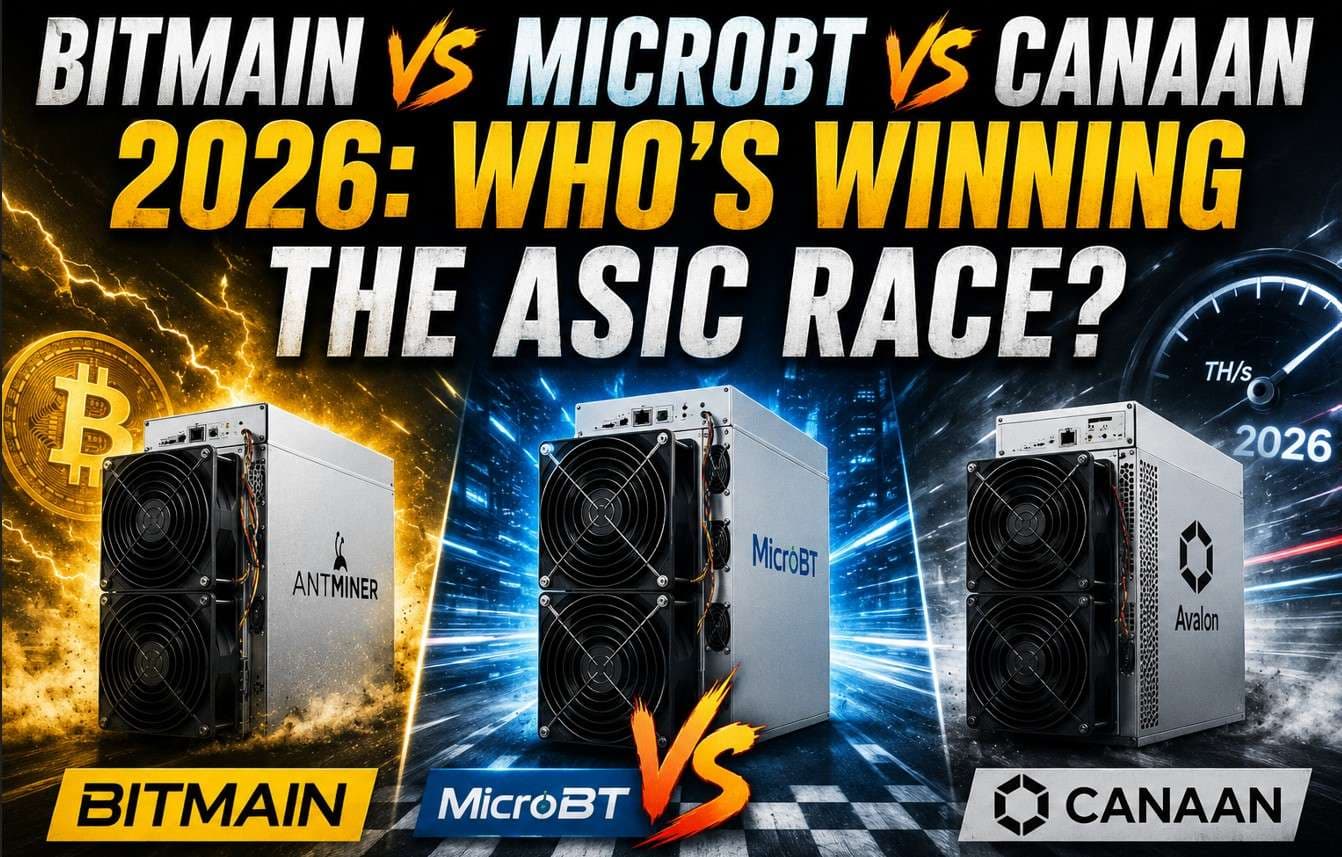
TLDR: Bitmain vs MicroBT vs Canaan 2026 At a Glance
- Bitmain leads on raw efficiency. The Antminer U3S23H Hydro runs at 9.5 J/TH with 1,160 TH/s�but it costs a lot.
- MicroBT's Whatsminer M79S Hydro hits 930 TH/s at 13.5 J/TH. It wins on field reliability and easy in-house maintenance.
- Canaan's Avalon A16 XP gives you 300 TH/s at 12.8 J/TH. It's the most affordable entry point and has the easiest user interface.
- Together, Bitmain, MicroBT, and Canaan control 97% of the global ASIC market in 2026.
- Bitmain fits large industrial farms. MicroBT suits mid-scale operators. Canaan is ideal for anyone scaling from 5 to 20 machines.
- Auradine and Bitdeer are entering the space�and they're worth watching right now.
The ASIC race in 2026 is faster and more cutthroat than ever. Bitcoin's network difficulty keeps going up. Post-halving margins are tight. And the three brands that have always run the show�Bitmain, MicroBT, and Canaan�are pushing each other harder than ever before.
So if you're trying to pick the right brand for your budget, this guide is for you. We break down efficiency, price, support, cooling, and which setup fits your scale. Also, we flag the new players that could shake things up. Let's dig in.
Quick Comparison: Bitmain vs MicroBT vs Canaan 2026
Feature
Bitmain
MicroBT
Canaan
2026 Flagship
Antminer U3S23H Hydro
Whatsminer M79S Hydro
Avalon A16 XP
Hashrate
1,160 TH/s
930 TH/s
300 TH/s
Efficiency
9.5 J/TH
13.5 J/TH
12.8 J/TH
Cooling Type
Hydro
Hydro
Air
Best For
Industrial farms
Mid-to-large scale
Scaling operators
Price Tier
Premium
Mid-high
Most affordable
Market Share
~75%
~15%
~7%
Bitmain in 2026: Still the King, But You'll Pay for It
Bitmain is still the top name in Bitcoin mining hardware. Their 2026 flagship is the Antminer U3S23H Hydro. It runs at 9.5 J/TH and pushes 1,160 TH/s. In fact, that makes it one of the most power-efficient SHA-256 miners ever built at commercial scale. That makes it one of the most power-efficient SHA-256 miners ever built. At $0.06 per kWh, daily profit runs around $27.50 per unit.
Bitmain holds roughly 75% of the global ASIC market. Their grip on mining setup is hard to shake. Almost every major hosting facility supports Antminer units out of the box. That means fewer setup headaches when you go to deploy. And it means more third-party firmware options, too.
One big 2026 move is Bitmain's push into US production. They're building out domestic factories to get ahead of the 25% tariffs on Chinese-made gear. For US miners, that's a real buying factor. Also, Bitmain gear holds its value best on the used market. That helps offset the high upfront cost when it's time to upgrade.
The downside? Direct buys need large minimum order sizes. Small operators get shut out. Some batches have also had cooling problems in poorly ventilated spaces. Still, if you need the most efficient machine at scale, Bitmain is still the call.
Best for: Large commercial farms with full hydro or immersion cooling in place.
MicroBT in 2026: The Reliable Challenger
MicroBT's Whatsminer M79S Hydro is the headline unit for 2026. It was announced at Bitcoin MENA in late 2025. It runs at 13.5 J/TH and pushes 930 TH/s. The price target is $25 to $30 per TH. It trails Bitmain on efficiency, but MicroBT earns its share a different way�through rock-solid build quality and easy maintenance.
So what makes MicroBT stand out? Whatsminer units are widely called the most field-friendly ASICs out there. Firmware access is simple. Repairs can be done in-house without a service center. The hardware holds up in tough conditions. That's huge when you run dozens of units far from a service shop.
Also, MicroBT's 2026 lineup leans hard into immersion-ready designs. The M7D and M79S are both built for immersion cooling. Hydro setups cut temps by 20 to 30% and boost uptime. So if your facility can support hydro, these units really shine.
MicroBT holds around 15% of global ASIC supply. Their share has grown year over year, making them Bitmain's biggest rival. They're not the cheapest option�but they compete on durability and real-world value. Also, their hashrate share has grown year after year. That trend alone shows this brand is doing something right.
Best for: Mid-to-large scale operations that want solid performance without full Bitmain dependence.
Canaan in 2026: Budget-Friendly and Often Overlooked
Canaan doesn't get enough credit. Their Avalon A16 XP is the air-cooled flagship for 2026. It delivers 300 TH/s at 12.8 J/TH. First shipments went out in March 2026. For operations scaling from 5 to 20 machines, the A16 XP is a great starting point.
Canaan has the most intuitive interface of any ASIC brand on the market. Their machines run stable. Their support team actually picks up the phone. When you're new to this hardware, that kind of help matters a lot.
Also worth noting: Canaan machines have lower fan and hashboard failure rates than similar Bitmain units. So while they don't top the raw performance charts, their real-world track record is stronger than most people think.
Canaan also has the lowest cost per terahash of the three. Their units come in small batch sizes. No large minimum orders. That makes them a top pick for investors who want to start small and scale up over time.
Just note that the A16 XP needs power below $0.08 per kWh to turn a solid profit. Power costs matter more here than with Bitmain's more efficient models.
Canaan (NASDAQ: CAN) was also the first ASIC maker to go public. That level of public finances is something neither Bitmain nor MicroBT can match. Best for: New operators, smaller investors, and anyone who values ease of use and real support.
Head-to-Head by Use Case: Bitmain vs MicroBT vs Canaan 2026
Not every miner runs the same setup. So instead of a one-size verdict, here's how the three brands stack up by operation size. Think of this as a buyer's guide, not just a brand ranking.
Which Brand Wins for Home and Small-Scale Miners?
None of the 2026 hydro flagships are built for home use. They're big, loud, and need industrial cooling. Instead, Canaan's Avalon Q is the go-to for home miners who want stable, low-noise operation at a manageable power cost. Bitmain and MicroBT's top 2026 models just aren't designed for that environment.
Which Brand Wins for Small Commercial Operators (5�20 Machines)?
This is Canaan's sweet spot in 2026. The A16 XP has an easy interface, low failure rates, and comes in small batch sizes. Additionally, Canaan's support team is fast and helpful. For smaller teams, that safety net matters when something breaks at 2 AM.
Which Brand Wins for Mid-Scale Operations (20�100 Machines)?
MicroBT takes this tier. The M79S Hydro gives you near-top-tier hash rate with proven reliability. In-house maintenance is manageable. And the total cost of ownership tends to be lower over time when you factor in uptime and repair costs.
Which Brand Wins for Industrial Farms (100+ Machines)?
Bitmain still owns this space. The U3S23H Hydro's 9.5 J/TH is unmatched at volume. Every big hosting provider runs it with no extra setup. And Bitmain's US production push means American operators may soon dodge tariff markups on new orders.
The Wildcards: Auradine and Bitdeer Are Coming
It's also worth flagging that the ASIC market isn't as locked in as it once was. Two new players are making noise in 2026 and deserve your attention.
Auradine is a US startup that gives miners a local option to Chinese-made ASICs. Their Teraflux AH3880 claims 600 TH/s at just 35 dB of noise. That spec sheet is turning heads. More importantly, they target US miners who want to avoid political supply chain risk.
Meanwhile, Bitdeer's Sealminer A2 offers 16.5 J/TH efficiency and signals a bigger trend. Large mining firms are now building their own ASIC hardware to cut out the middleman. External Sealminer sales are still limited. But this vertical push will reshape third-party ASIC pricing in the years ahead.
Also, neither player is ready to threaten Bitmain's 75% share just yet. Still, watching them now puts you ahead of the curve. In fact, the miners who tracked MicroBT back in 2018 when they were new got great prices before the brand blew up. The same logic applies here.
What to Look for Beyond Brand Name
When you compare ASIC makers in 2026, don't just chase the headline hashrate. Here's what actually drives your bottom line.
- Efficiency (J/TH) is the most critical number. Lower J/TH means less electricity cost per terahash. At scale, even a 1 J/TH gap can mean thousands of dollars per month.
- Cooling type is increasingly non-negotiable. Hydro and immersion setups cut temps by 20 to 30% and push uptime higher. If your facility can support it, go hydro.
- Firmware and repairability is where MicroBT wins clearly. Easy access and in-house repair cut maintenance costs�especially for teams without dedicated tech staff on site.
- Resale value favors Bitmain by a wide margin. Antminers are the most liquid ASIC on global secondary markets. So if you upgrade every 18 to 24 months, Bitmain's premium partially pays for itself on the exit.
- Support and warranty goes to Canaan. They're the most responsive of the three. Bitmain and MicroBT are harder to reach for smaller buyers without big volume contracts.
- Market share and supply also matter when you're placing large orders. Bitmain, MicroBT, and Canaan together supply over 95% of all ASIC hardware worldwide. So supply chain problems at any one of these brands can ripple across the whole market. It's smart to know your brand's production outlook before you commit to a big order.
FAQ: Bitmain vs MicroBT vs Canaan 2026
Is Bitmain still the best ASIC manufacturer in 2026?
For raw efficiency and industrial scale, yes. The Antminer U3S23H Hydro at 9.5 J/TH is the most power-efficient SHA-256 miner on the market right now. However, Bitmain suits large farms best. If you're running fewer machines or watching your budget, MicroBT or Canaan often make more sense for your setup.
How does MicroBT compare to Bitmain on efficiency in 2026?
MicroBT's M79S Hydro runs at 13.5 J/TH versus Bitmain's 9.5 J/TH. So Bitmain wins on pure efficiency. But MicroBT beats Bitmain on real-world uptime, easy fixes, and total costs at mid-scale. For operators running 20 to 100 machines, MicroBT is often the smarter financial call.
Which ASIC manufacturer is best for small-scale mining in 2026?
Canaan is the clear pick. Their Avalon A16 XP and Avalon Q series are built with smaller miners in mind. Low minimum orders, a simple interface, and fast support make Canaan the friendliest way into commercial ASIC mining in 2026.
What is the ASIC market share breakdown in 2026?
Bitmain, MicroBT, and Canaan together hold about 97% of the global ASIC hardware market in 2026. Bitmain leads at around 75%. MicroBT holds roughly 15%. Canaan sits at about 7%. Auradine and Bitdeer are beginning to carve out small pieces, but the big three still run the show.
Should US miners worry about tariffs when buying ASICs in 2026?
Yes, for sure. A 25% tariff on Chinese-made gear hits your upfront cost hard. Bitmain's US production push aims to ease that pain over time. Auradine is also worth watching as a tariff-free domestic option that's gaining real traction in the US market this year.
Final Verdict: Bitmain vs MicroBT vs Canaan 2026
So who wins the Bitmain vs MicroBT vs Canaan 2026 showdown? It really comes down to your situation.
Choose Bitmain if you run a large industrial farm, need the best efficiency on the market, and have the capital for premium pricing. The Antminer U3S23H Hydro is the top unit in 2026. Full stop.
Choose MicroBT if you want strong performance with better reliability and lower long-term maintenance costs. The Whatsminer M79S Hydro is a true workhorse. It holds up where it counts.
Choose Canaan if you're scaling from scratch, want an easy setup experience, and need the best price-per-terahash available. The Avalon A16 XP is a smart, practical choice for growing operations in 2026.
All three brands can be profitable. But only with the right electricity rate, the right cooling setup, and the right scale. So run your numbers first. Your break-even point depends on your power cost more than any spec sheet ever will. Also, don't sleep on the secondary market. Used Antminers and Whatsminers can give you solid ROI at a fraction of the new-unit price. And finally, keep an eye on network difficulty trends.
Even the best miner can lose money if the difficulty spikes and your power rate isn't strong. Mine smart, not just hard. In short, the best ASIC brand in 2026 is the one that fits your power rate, your scale, and your support needs. That answer looks different for everyone.
Ready to Mine Smarter? Meet EndlessMining.com
If you�re serious about crypto mining, challenges like � trust, accountability, security, and efficiency � are problems you face every day. That�s exactly why�EndlessMining.com�was built.
EndlessMining.com is the mining hardware marketplace that actually has your back:
- ?�Buy & Sell Mining Hardware�� Browse a curated�marketplace�connecting miners, dealers, and buyers worldwide.
- ?�Hosting Services�� Skip the overhead. Let EndlessMining host your miners in professional facilities so you can focus on returns.
- ?�Mining Consultancy�� Get expert guidance on equipment selection, setup, and optimization from people who live and breathe mining.
- ?�Mining Calculator�� Run the numbers before you commit. Estimate profitability based on your hardware, power costs, and current network conditions.
- ?�Escrow-Protected Transactions�� EndlessMining.com is currently the�only crypto miner marketplace officially partnered with Escrow.com, meaning every transaction is protected. No scams. No chargebacks. No uncertainty. In a space defined by trustlessness, Endlessmining.com offers something rare:�accountability you can count on.