Coldcard Security Scare: What Every Bitcoin Holder Needs to Know
An investigation into a major wallet security incident, what it means for self-custody, and how to protect your Bitcoin.
Nearly $38 million worth of Bitcoin disappeared in one of the most significant hardware wallet security incidents the Bitcoin community has seen in years. Approximately 594.5 BTC was drained from hundreds of wallets in what appears to have been a highly coordinated attack completed in roughly 25 minutes.
Unlike many crypto hacks that target exchanges or decentralized finance platforms, this incident struck at something much more fundamental: the process used to generate Bitcoin wallet seed phrases.
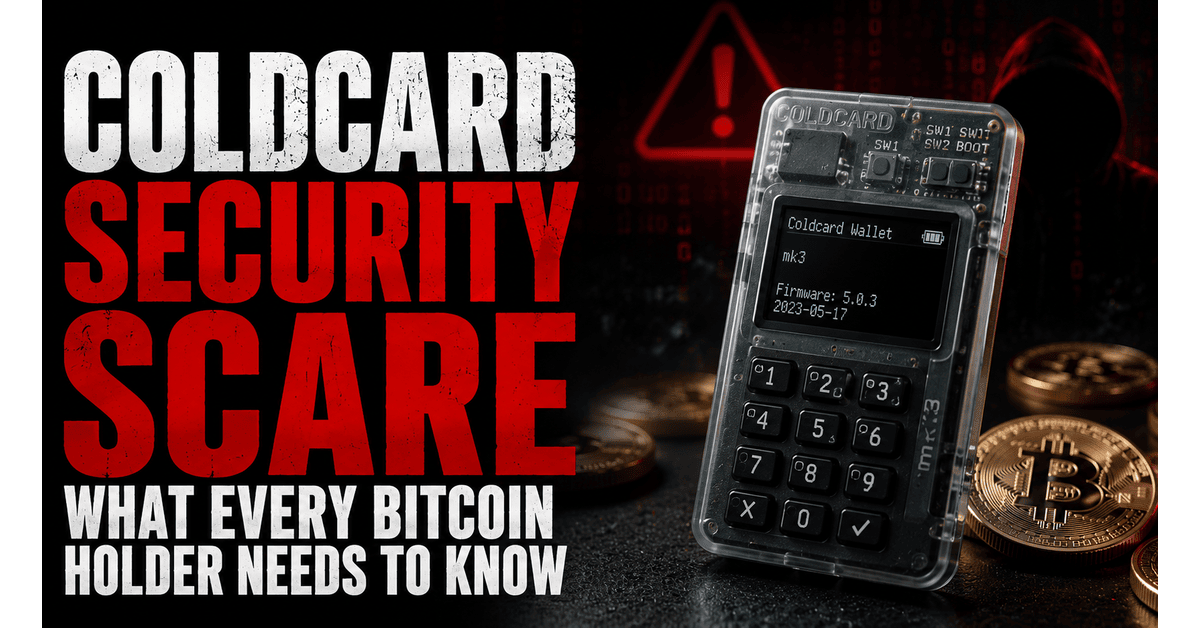
The wallets involved were believed to have been created using certain versions of the COLDCARD Mk3, one of the most respected Bitcoin-only hardware wallets available today. Naturally, the news quickly spread throughout the Bitcoin community and raised concerns among hardware wallet users everywhere.
Was COLDCARD Hacked?
The short answer is no. Not in the traditional sense.
At the time of writing, there is no evidence that modern COLDCARD devices have been remotely compromised or that Bitcoin's cryptography has been broken. Instead, investigators believe the issue may stem from the randomness, known as entropy, used when certain wallet seeds were originally generated.
If the randomness used to create a seed phrase isn't truly random, it may become possible for an attacker to dramatically reduce the number of possible combinations needed to recreate that seed. Rather than searching through an unimaginably large number of possibilities, an attacker may only need to search through a much smaller subset.
Think of it like rolling a six-sided die. If you know the die has been secretly weighted to only land on three numbers instead of six, your chances of guessing the outcome become much higher. The same concept applies to cryptographic randomness.
What Is Entropy?
Entropy is one of the most important parts of Bitcoin security, yet it's something many users never think about.
When you initialize a hardware wallet, it creates a completely random 12- or 24-word recovery phrase. That phrase ultimately controls every Bitcoin address and every private key associated with the wallet.
Good entropy means those words are effectively impossible for anyone else to predict.
Poor entropy means there may be hidden patterns that reduce the number of possible combinations, making an attack more feasible.
Hardware wallets are specifically designed with hardware random number generators to produce high-quality randomness. Many wallets, including COLDCARD, also allow users to contribute their own randomness by rolling physical dice. This creates an additional layer of protection because the final seed depends not only on the hardware but also on user-generated randomness.
Ironically, this optional feature has become one of the biggest talking points following the incident.
Which Devices Are Potentially Affected?
According to Coinkite's security advisory, the investigation currently centers around:
- COLDCARD Mk3 devices
- Firmware versions 4.0.1 through 5.0.3
The company has stated that there is currently no indication that newer models, including the Mk4, Mk5, or COLDCARD Q, are affected.
Additionally, wallets protected with a BIP-39 passphrase appear to be at significantly lower risk because the passphrase adds another layer of cryptographic protection beyond the seed phrase itself.
Did Artificial Intelligence Help Discover the Flaw?
One of the most interesting aspects of this story is the growing speculation surrounding artificial intelligence.
Several security researchers believe AI may have played a role in identifying subtle mathematical patterns that humans might have overlooked. While there is no public confirmation that AI directly discovered the weakness, many experts believe modern AI systems are becoming increasingly capable of analyzing enormous datasets and uncovering vulnerabilities that previously went unnoticed.
If that's true, it represents an important shift in cybersecurity.
Bitcoin's cryptography remains incredibly strong, but implementation flaws, poor randomness, and software bugs may become easier to detect as AI-powered analysis continues to improve.
This doesn't mean AI can break Bitcoin. It means AI may become another powerful tool for finding mistakes made by developers.
What Should COLDCARD Mk3 Owners Do?
If you generated a wallet on an affected COLDCARD Mk3 during the timeframe under investigation, security experts recommend taking precautionary action.
The safest approach includes:
- Move your Bitcoin to a newly generated wallet.
- Create a brand-new seed phrase on unaffected hardware.
- Use a BIP-39 passphrase if it fits your security strategy.
- Consider adding your own entropy by rolling physical dice during wallet creation.
- Test small transactions before transferring your full balance.
Even if investigators ultimately determine your wallet is safe, migrating to a newly generated seed can provide peace of mind.
Does This Mean Hardware Wallets Are No Longer Safe?
Absolutely not.
In fact, this incident reinforces why hardware wallets remain the gold standard for Bitcoin self-custody.
Notice what did not happen:
- Bitcoin itself was not hacked.
- SHA-256 encryption was not broken.
- Private keys were not magically extracted from secure hardware.
Instead, investigators are examining whether a specific implementation of random number generation may have produced weaker-than-expected randomness on certain devices.
That's a very important distinction.
Finding a flaw in one implementation does not mean Bitcoin's underlying security has failed. It's similar to discovering that one manufacturer produced a faulty lock. It does not mean every lock in the world suddenly became insecure.
Lessons Every Bitcoin Holder Can Learn
Whether or not you own a COLDCARD, this incident serves as a valuable reminder about Bitcoin security.
Always purchase hardware wallets directly from the manufacturer or an authorized reseller.
Keep your wallet firmware up to date so you receive the latest security improvements.
Protect your recovery seed carefully and never store it digitally where it could be compromised.
If your wallet allows you to add your own entropy through dice rolls or another method, consider taking advantage of that feature for additional peace of mind.
Finally, remember that layered security is your friend. Passphrases, multisignature wallets, secure backups, and geographically separated storage locations all reduce the risk of a single point of failure.
Final Thoughts
Bitcoin's greatest strength is that it allows individuals to truly own and control their money without relying on banks or third parties.
That freedom also comes with responsibility.
While headlines about nearly $38 million being stolen can sound alarming, the bigger lesson isn't that Bitcoin has failed. Instead, it's a reminder that self-custody requires understanding the tools you're using and following security best practices.
Hardware wallets remain one of the safest ways to store Bitcoin, and incidents like this ultimately help strengthen the ecosystem by exposing weaknesses that can be fixed before they become widespread.
As investigators continue to determine exactly what happened, this event will likely become one of the most studied hardware wallet security incidents in Bitcoin's history and a valuable lesson for every Bitcoiner committed to protecting their wealth.