Hydro-Cooled Mining vs Air-Cooled Mining: What's the Future in 2026?
Hydro cooling is the use of a liquid substance to cool heat-producing elements or components in a crypto mining device. Also known as liquid cooling, the cooled element doesn�t come into contact with the liquid. The heat on the components is absorbed by the
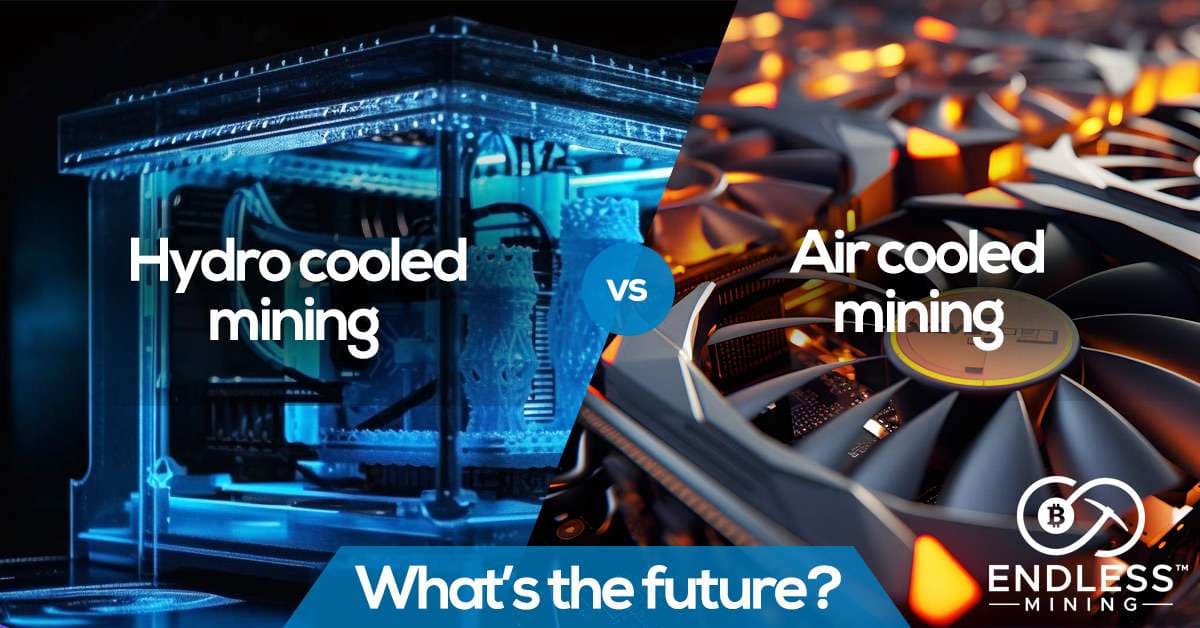
Hydro-cooled mining vs air-cooled mining | Last Updated June 2026
TLDR: Hydro-Cooled Mining vs Air-Cooled Mining at a Glance
- Air cooling is cheaper upfront and easier to set up � great for home miners and beginners
- Hydro cooling uses liquid coolant to pull heat directly from ASIC chips � far more efficient than fans alone
- Immersion cooling is the most advanced option, submerging entire miners in non-conductive fluid for peak thermal performance
- Thermal throttling is a real problem with air-cooled setups � when temps spike, your hashrate drops and profits shrink
- Hydro-compatible ASICs like the Antminer S21 Hydro and WhatsMiner M63S Hydro deliver better performance and longer lifespan than their air-cooled counterparts
- Setup costs for air cooling run $50�$300 in fans and ventilation; hydro cooling systems start at $500�$2,000+ per unit
- Long-term ROI favors hydro cooling for large-scale operations, while air cooling wins short-term ROI for small home setups
- Energy efficiency is better with hydro � liquid moves heat faster and uses less power than banks of high-speed fans
- Noise levels drop significantly with hydro � fanless hydro miners like the S21 Hydro run near-silent compared to air-cooled units screaming at 75�80 dB
- Climate matters � miners in hot regions like the South or Southwest get more bang from hydro cooling than those in cooler states
- The future belongs to hydro � institutional miners and large farms are already shifting away from air cooling as 3nm chip technology pushes heat density higher
What Is Hydro-Cooled Mining?
Hydro-cooled mining, also called liquid cooling for crypto mining, uses water-based coolant to pull heat away from the chips inside your ASIC miner. The coolant flows through sealed tubes and water blocks attached directly to the heat-generating components. It then carries that heat to an external radiator or cooling tower, releases it, and cycles back � over and over.
This method keeps chip temperatures tight and consistent. Because of that, your miner runs at full speed without backing off due to heat. Notably, modern hydro-compatible ASICs like the Antminer S21 Hydro and WhatsMiner M63S Hydro ship sealed and fan-free. They're purpose-built for liquid cooling loops from day one.
Advantages of Hydro Cooling for ASIC Miners
- Superior efficiency � liquid coolant moves heat 20�30x faster than air
- Stable hash rates � no thermal throttling means your miner delivers consistent output
- Near-silent operation � without roaring fans, noise drops to a whisper
- Longer hardware lifespan � lower operating temps reduce chip wear over time
- Compact deployments � hydro miners rack closer together since heat management doesn't rely on airflow clearance
Disadvantages of Hydro Cooling
- Higher upfront cost � a full hydro loop (pump, coolant, water blocks, radiator, plumbing) can run $500�$2,000 per miner depending on scale
- Professional setup required � leaks or improper installation can damage expensive hardware
- More moving parts � you're managing a plumbing system alongside a mining operation
What Is Immersion Cooling for Bitcoin Mining?
Immersion cooling takes the liquid cooling concept further. Instead of running coolant through tubes, you submerge the entire ASIC miner in a specially engineered dielectric fluid. This fluid doesn't conduct electricity � so no short circuits � but it pulls heat away from every chip, capacitor, and trace on the board simultaneously.
Consequently, immersion cooling delivers the most thermally effective performance available today. Large-scale Bitcoin mining farms, particularly those running next-gen 3nm ASICs, increasingly use immersion tanks to manage extreme heat density.
Advantages of Immersion Cooling
- Maximum thermal performance � full-body contact with coolant delivers unmatched heat removal
- Lower energy use � no high-powered fans or heavy HVAC systems required
- Extended hardware life � stable, low temps dramatically reduce component degradation
- Near-zero fan maintenance � no fan replacements, no dust buildup, no filter cleaning
Disadvantages of Immersion Cooling
- Highest initial cost � custom tanks, dielectric fluid, and infrastructure can run $10,000�$50,000+ for a full deployment
- Complex setup � requires professional planning and installation
- Not DIY-friendly � mistakes here are expensive and can destroy hardware
What Is Air-Cooled Mining?
Air cooling is the OG method and still the most widely used ASIC miner cooling approach in 2026. It works by using built-in fans to push hot air away from internal components and pull in cooler air from outside. Most standard ASICs � like the Antminer S21 Pro and WhatsMiner M60S � ship with air cooling right out of the box.
Air cooling is also plug-and-play. You don't need a plumber or specialized equipment. Just rack the miners, give them airflow, and you're hashing.
Advantages of Air Cooling
- Low upfront cost � fans and ventilation upgrades run $50�$300 for most setups
- Easy to install � no professional help needed for standard deployments
- Widely compatible � works with virtually every ASIC on the market
- Fast ROI � lower capital costs mean you break even faster
Disadvantages of Air Cooling
- Thermal throttling � when ambient temps rise, air-cooled miners cut hashrate to protect chips
- Higher energy consumption � industrial fans and HVAC systems pull significant power on top of miners
- Noise pollution � air-cooled ASICs commonly hit 70�80 dB, which is genuinely loud
- Dust and maintenance � filters clog, fans wear out, and dust buildup reduces airflow over time
- Scaling bottleneck � as your farm grows, air cooling becomes a real performance ceiling
Hydro-Cooled Mining vs Air-Cooled Mining: Head-to-Head Comparison
Here's how the two methods stack up across the metrics that matter most:
Factor
Air Cooling
Hydro Cooling
Upfront Cost
$50�$300
$500�$2,000+ per unit
Efficiency
Moderate
High
Noise Level
70�80 dB
Near-silent
Energy Use
Higher (fans + HVAC)
Lower (pump only)
Hashrate Stability
Drops with heat
Consistent
Maintenance
Frequent (fans, dust)
Low
Hardware Lifespan
Shorter
Longer
Best For
Home/small miners
Large-scale farms
Setup Complexity
Simple
Moderate to complex
Long-Term ROI
Better short-term
Better long-term
The Thermal Throttling Problem in Air-Cooled Mining
Thermal throttling is one of the biggest hidden costs in air-cooled mining. Here's what happens: when an air-cooled ASIC overheats, the firmware automatically slows its clock speed to protect the chips. As a result, your hashrate drops � sometimes by 10�20% � and your mining revenue shrinks right along with it.
Furthermore, in hot climates like Texas, Arizona, or Florida, summer temps can push ambient temps above the threshold where air cooling stays effective. Miners end up running massive HVAC systems just to keep air cool enough, which drives energy costs through the roof.
Hydro-cooled miners sidestep this entirely. Because liquid coolant keeps chip temps tight, there's no throttling trigger. So your Antminer S21 Hydro delivers its rated 335 TH/s day after day, regardless of the thermometer outside.
Hydro-Cooled Mining vs Air-Cooled Mining: ROI Breakdown
The ROI question is where things get real. Neither method is universally better � it depends on your scale and timeline.
For home miners and small operations: Air cooling wins the short-term ROI race. Lower capital costs mean you recover your investment faster. If you're running 2�5 miners at home, a hydro setup's added expense rarely pays off quickly enough to justify it.
For serious miners and large farms: Hydro cooling wins hands down over a 3�5 year horizon. Lower energy bills, higher uptime, reduced maintenance, and longer hardware lifespan combine to deliver significantly better returns. Many institutional miners running 100+ units report 15�25% lower operating costs with hydro versus air.
Climate is a major factor too: If you mine in a hot region, hydro cooling isn't just better � it may be necessary to stay competitive. Air-cooled operations in high-heat environments often spend more on cooling infrastructure than hydro would have cost upfront.
Who Should Choose What? A Practical Decision Guide
This is where the hydro-cooled mining vs air-cooled mining debate gets personal. Your best option depends on your specific situation.
Go with air cooling if:
- You're a beginner or home miner with under 10 units
- You're on a tight budget and need fast ROI
- You mine in a naturally cool climate
- You want a simple, no-fuss setup
Go with hydro cooling if:
- You're running 10+ units and serious about long-term profits
- You're in a hot climate where air cooling underperforms
- You want near-silent operation � great for residential or urban setups
- You're buying next-gen ASICs that generate serious heat
Consider immersion cooling if:
- You're building an industrial-scale Bitcoin mining farm
- You're running high-density racks with 3nm generation miners
- Uptime and hardware longevity are your top priorities
Best Hydro-Cooled and Air-Cooled ASICs in 2026
The hardware market has responded fast to cooling demand. Here's where things stand in 2026:
Top hydro-cooled ASICs:
- Antminer S21 Hydro � 335 TH/s at ~5,360W, designed exclusively for liquid cooling
- WhatsMiner M63S Hydro � 390 TH/s, one of the most power-efficient hydro miners available
- Antminer S21+ Hydro � 319 TH/s with improved J/TH efficiency over the base model
Top air-cooled ASICs:
- Antminer S21 Pro � 234 TH/s, solid workhorse for mid-scale air-cooled operations
- WhatsMiner M60S � 186 TH/s with competitive efficiency for an air-cooled unit
- Canaan Avalon Made A15 � reliable budget-friendly option for smaller air-cooled setups
Hydro-compatible miners consistently push higher raw hash rates. That's because better thermal management lets manufacturers run chips harder without damage.
Why Hydro-Cooled Mining Is the Future
The direction of the industry is pretty clear. Several forces are pushing miners toward hydro cooling in 2026 and beyond.
Chip technology is getting hotter. The move to 3nm and upcoming 2nm fabrication processes packs more compute into smaller dies. However, it also concentrates heat. Air cooling simply can't keep up with next-gen hash board temperatures at full load.
Energy costs stay under pressure. With Bitcoin network difficulty hitting record highs in 2026, miners need every efficiency edge available. Hydro cooling's lower energy overhead directly improves profit margins when every sat counts.
Noise and regulatory friction are real. Loud, power-hungry air-cooled farms attract attention from neighbors and regulators alike. Quieter, more efficient hydro setups are easier to permit and operate � especially in urban or suburban environments.
Institutional capital demands it. As more public mining companies and Wall Street-backed operators enter the space, professional-grade infrastructure � including hydro cooling � has become a baseline expectation rather than a premium option.
FAQ: Hydro-Cooled Mining vs Air-Cooled Mining
Is hydro cooling worth it for small home miners?
For most home miners running fewer than 5 units, air cooling is the smarter starting point. The upfront cost of a proper hydro system rarely pays off at small scale. However, if you plan to expand your operation over the next year or two, building a hydro-ready setup from the start saves you a costly rebuild later.
Can you convert an air-cooled ASIC to hydro cooling?
In most cases, no � not without voiding your warranty and doing serious modification work. Hydro-compatible ASICs like the Antminer S21 Hydro are purpose-built for liquid cooling at the factory. Standard air-cooled models don't have the water block mounts or sealed chassis required for a proper hydro loop. Third-party conversion kits exist, but they carry real risk and complexity.
What happens if there's a leak in a hydro cooling system?
A leak can damage or destroy hardware if it isn't caught quickly. That's why professional installation and regular system checks are so important. Quality setups use corrosion-resistant tubing, solid fittings, and coolant additives that reduce leak risk. When set up properly by pros like Endless Mining, hydro systems are highly reliable.
How much quieter is hydro cooling vs air cooling?
The difference is night and day. A typical air-cooled ASIC runs at 70�80 dB � roughly as loud as a vacuum cleaner running nonstop. Hydro-cooled miners like the Antminer S21 Hydro run near-silently since they have zero internal fans. The only noise comes from the external pump, which typically runs under 45 dB.
Does hydro cooling actually improve hash rate?
Yes � though not by overclocking the chip. Instead, hydro cooling eliminates thermal throttling, so your miner consistently hits its rated hash rate rather than backing off when temps climb. Over a 24-hour period, that steady output adds up to measurably more mined Bitcoin compared to an air-cooled unit that throttles during hot stretches.
What coolant do hydro mining systems use?
Most hydro loops for ASICs use deionized water mixed with a propylene glycol-based additive � similar to automotive antifreeze. This mixture prevents corrosion, stops biological growth, and lowers the fluid's freezing point. Immersion systems use a different fluid entirely � typically a synthetic dielectric fluid from brands like 3M Novec or Engineered Fluids, which is non-conductive and safe for direct chip contact.
The Bottom Line on Hydro-Cooled Mining vs Air-Cooled Mining
There's no single universal winner in the hydro-cooled mining vs air-cooled mining debate � just the right pick for your situation. Air cooling is perfectly fine if you're starting out, running a small home operation, or working in a cool climate. It's cheap, simple, and gets the job done.
But if you're building a serious mining business in 2026, hydro cooling is where the industry is heading. Better efficiency, lower noise, longer hardware lifespan, and consistent hash rates all point in the same direction. As chip technology keeps advancing and energy margins stay tight, hydro-cooled mining isn't just the future � it's rapidly becoming the standard for anyone mining at real scale.
Ready to set up a professional hydro cooling system for your operation? Endless Mining specializes in liquid and immersion cooling installations for ASIC miners across the US. Reach out and let's build the right cooling setup for your goals.
Ready to Mine Smarter? Meet EndlessMining.com
EndlessMining.com is the mining hardware marketplace that actually has your back:
- ?�Buy & Sell Mining Hardware�� Browse a curated�marketplace�connecting miners, dealers, and buyers worldwide.
- ?�Hosting Services�� Skip the overhead. Let EndlessMining host your miners in professional facilities so you can focus on returns.
- ?�Mining Consultancy�� Get expert guidance on equipment selection, setup, and optimization from people who live and breathe mining.
- ?�Mining Calculator�� Run the numbers before you commit. Estimate profitability based on your hardware, power costs, and current network conditions.
- ?�Escrow-Protected Transactions�� EndlessMining.com is currently the�only crypto miner marketplace officially partnered with Escrow.com, meaning every transaction is protected. No scams. No chargebacks. No uncertainty. In a space defined by trustlessness, Endlessmining.com offers something rare:�accountability you can count on.