Immersion Cooling for ASIC Miners: Is It Worth It?
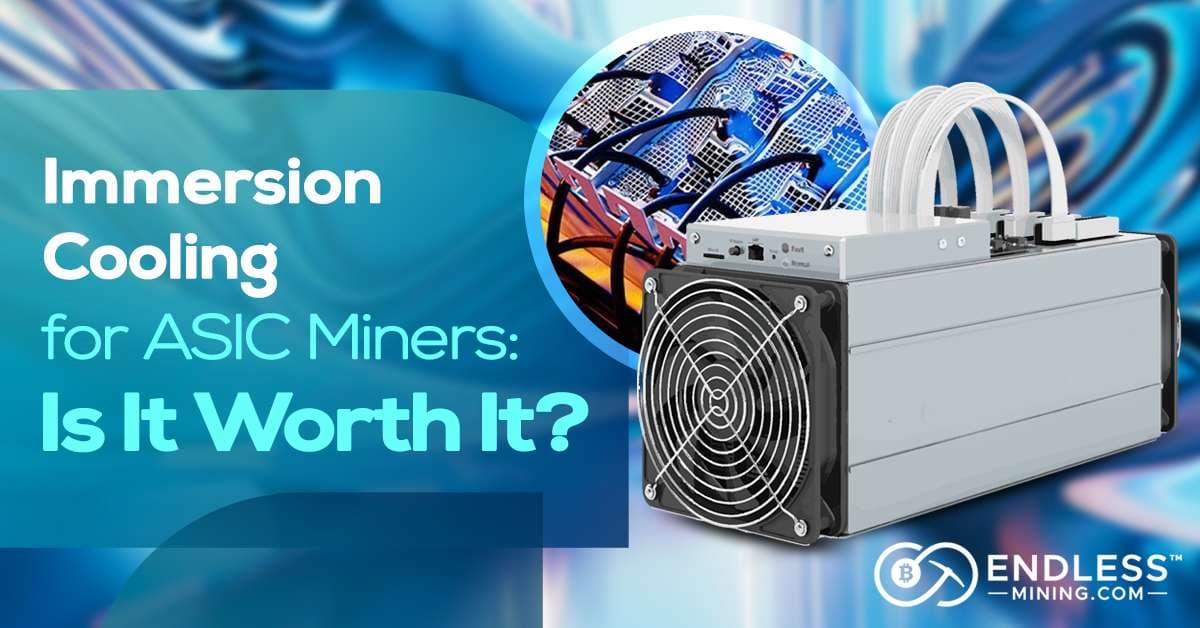
TL;DR: Immersion Cooling for ASIC Miners: Is It Worth It?
- Immersion cooling for ASIC miners submerges hardware in dielectric fluid, removing fans and dramatically improving heat dissipation.
- It can cut cooling energy use by up to 40�50% and improve mining efficiency by 5�10% in joules per terahash.
- Upfront costs range from roughly $4,000 for a small home tank to $15,000+ for a 6-unit setup � not counting fluid top-ups.
- The break-even point for home miners (1�3 units) stretches beyond 24 months in most scenarios.
- At 10+ units, the math changes significantly. Industrial-scale operations see the clearest ROI.
- Purpose-built hydro-cooled ASICs are a separate and often smarter choice in 2026.
- If you run fewer than 5 miners and pay under $0.07/kWh, air cooling is likely still your best bet.
What Is Immersion Cooling for ASIC Miners, Exactly?
Let's start simple. Immersion cooling means you take your ASIC miner � your Antminer S21, your Whatsminer M60, whatever you run � and fully submerge it in a special non-conductive liquid called a dielectric fluid. As a result, the fluid absorbs heat directly from every chip, capacitor, and trace on the hashboard. Then it either flows to a heat exchanger or evaporates and recondenses, depending on your system type.
Why does this work so well? Air is a poor conductor of heat. Liquid is far better. Dielectric fluid transfers heat roughly 1,000 times more efficiently than air. So instead of pushing hot air around a room with fans, you pull heat away from the source the moment it generates.
There are two types you need to know about:
Single-phase immersion cooling keeps the fluid in liquid form throughout the whole cycle. The fluid heats up, a pump moves it to an external heat exchanger, it cools down, and it recirculates. This is the more affordable and widely used option in 2026, especially for small and mid-scale operations.
Two-phase immersion cooling uses a fluid with a very low boiling point. The fluid boils around the hot components, carries heat away as vapor, and then condenses back to liquid at the top of the tank. Heat transfer is even more efficient this way, but setup costs are significantly higher and the fluids are pricier.
For most miners reading this, single-phase is therefore the relevant option.
How Immersion Cooling for ASIC Miners Actually Performs
Here is where things get interesting. The performance claims around immersion cooling are real � but they carry important caveats.
- Noise reduction is immediate and dramatic. Standard air-cooled ASICs run at 75�80 decibels. That is loud enough to cause discomfort in an enclosed space over time. Immersion systems eliminate the fans entirely. The only remaining noise is the quiet hum of the pump � a completely different experience.
- Thermal stability improves significantly. With immersion, chip temperatures stay consistent regardless of ambient conditions. If you operate in a hot climate � East Africa, the American Southwest, parts of Southeast Asia � air-cooled farms regularly throttle or shut down during heat waves. Immersion systems maintain uptime because outside temperatures stop mattering as much.
- Efficiency gains are real but modest. Data from 2025 and 2026 shows that immersion can cut overall energy use by 40�50% compared to traditional air-cooled facilities when you factor in the eliminated air conditioning load. In terms of raw mining efficiency, expect a 5�10% improvement measured in joules per terahash. That matters at scale. For a single miner, it is not dramatic on its own.
- Hardware longevity improves noticeably. No fans means no fan bearing failures � still the most common single point of failure on any ASIC. Beyond that, the sealed fluid environment protects hashboards from dust, humidity, and airborne corrosion. Consequently, many operators report immersion-cooled machines running significantly longer between repairs.
The Real Costs: Breaking Down the ROI for Immersion Cooling for ASIC Miners
This is the section most guides skip. So let's go through it properly.
Upfront equipment costs (2026 estimates):
Setup Size
Tank Cost
Fluid Cost
Heat Exchanger
Total Upfront
1�2 units (home)
$2,500�$4,000
$800�$1,500
$500�$1,000
~$4,000�$6,500
3�6 units (small farm)
$5,000�$9,000
$2,000�$4,000
$1,500�$2,500
~$9,000�$15,000
10�50 units (mid-scale)
$15,000�$50,000
$6,000�$20,000
$5,000�$15,000
~$25,000�$85,000
Monthly savings from switching to immersion (per unit):
A single Antminer S21 draws around 3,500W. The fans consume roughly 150�200W. So, removing fans saves approximately $8�12/month at $0.07/kWh. Add the reduced AC and ventilation load, and you might realistically save $20�30/month per unit in a well-optimized setup.
Break-even math:
Consider a home miner with 2 units spending $5,000 on an immersion setup and saving $50/month. The break-even point is 100 months � over 8 years. That is a hard investment to justify on cooling savings alone.
However, for a mid-scale operator running 20 units, a $40,000 system breaks even in under 7 years. It saves $500�600/month along the way. Meanwhile, you extend hardware lifespan, reduce maintenance costs, and improve mining efficiency across the board.
The verdict? Immersion cooling for ASIC miners makes strong financial sense at 10+ units. Below that threshold, the numbers are difficult to justify unless noise, heat, or space constraints force the issue.
Air Cooling vs Immersion Cooling vs Hydro-Cooled ASICs
Most comparisons pit air against immersion. But in 2026, a third option changes the picture significantly: purpose-built hydro-cooled ASICs.
Manufacturers including Bitmain have released miners designed from the ground up for liquid cooling. These units ship without fans and connect directly to a water-cooling loop. You avoid the messy retrofit of submerging a fan-equipped machine in dielectric fluid � and the warranty stays intact since the machine was built for this.
Here is a quick comparison across all three approaches:
Factor
Air Cooling
Immersion Cooling
Hydro-Cooled ASIC
Upfront cost
Low
High
Medium�High
Noise level
75�80 dB
~30�40 dB
~40�50 dB
Efficiency gain
Baseline
5�10% better
5�15% better
Maintenance
Fan replacements
Fluid top-ups, leaks
Water loop upkeep
Scalability
Good
Excellent at scale
Good
Warranty risk
None
High (retrofit)
None (purpose-built)
Best for
Home / small farms
10+ unit operations
Single high-performance units
So, hydro-cooled ASICs are worth serious consideration in 2026. They solve the noise and thermal management problem without requiring you to build an immersion tank infrastructure. Furthermore, the total setup cost is often lower than a full immersion rig, especially when you factor in the dielectric fluid.
Who Should Use Immersion Cooling for ASIC Miners
So, who is this technology actually built for? Let's be direct.
You are a strong candidate for immersion cooling if:
You run 10 or more units and your power costs sit above $0.07/kWh, making efficiency gains meaningful over a 3�5 year horizon. Also, you are operating in a warm climate where air cooling infrastructure is expensive or unreliable. You need near-silence � for example, you run a mining operation inside or adjacent to a commercial or residential space. Alternatively, you are planning significant scale-up and want cooling infrastructure that grows with you.
Additionally, if your facility can repurpose the waste heat � for space heating, water heating, or nearby industrial processes � immersion cooling becomes even more attractive from an energy economics perspective. Several large operations in Texas and Iceland have deployed immersion for exactly this reason. It enables higher hardware density in buildings that would otherwise require massive HVAC investment.
Who Should NOT Use Immersion Cooling for ASIC Miners
This is the section nobody else writes. But it is equally important.
Skip immersion cooling if:
- You run fewer than 5 miners at home. As the break-even analysis shows, the payback period simply does not make financial sense at that scale. You are paying under $0.06/kWh. In other words, the monthly savings are too small to recover the infrastructure spend within any reasonable timeframe.
- You are on a short hardware cycle and plan to resell within 12�18 months. You will not recover the setup cost before the machines turn over. Similarly, you are in borrowed or leased facility space. Building immersion infrastructure in a space you do not own is a genuine risk. Simply put, you cannot easily relocate a fluid-filled tank system.
- Finally, if you are still learning the mining business, skip immersion for now. It adds significant operational complexity. Specifically, you are dealing with fluid compatibility checks, leak prevention, pump maintenance, and heat exchanger sizing. Master air-cooled operations first, then scale into immersion when the unit economics are clearly there.
- One more critical point: submerging an ASIC not designed for liquid cooling voids most manufacturer warranties. Bitmain, MicroBT, and Canaan all include this in their product terms. That is real downside risk if a hashboard fails during your coverage window.
The 2026 Reality: When Does Immersion Cooling for ASIC Miners Pay Off?
Let's ground this in what is actually happening in the market right now.
In 2026, Bitcoin mining difficulty continues to climb. Next-generation ASICs push power densities higher, which means thermal management is increasingly a competitive variable rather than just an operational checkbox. Miners who run their hardware harder and more consistently gain a compounding advantage. Fewer thermal failures compound that edge over time.
Immersion cooling directly addresses all three of those variables. Nevertheless, it addresses them at a cost that only becomes clearly worthwhile above a certain operational scale.
In short, the sweet spot for immersion cooling for ASIC miners in 2026 looks like this: a mining farm of 15�50 units, paying $0.05�$0.08/kWh, operating in a warm or noise-sensitive environment, with a 3�5 year operational horizon. For that profile, immersion cooling delivers both financial ROI and operational benefits that justify the upfront spend.
Below that scale, hydro-cooled ASICs or a well-ventilated air-cooled setup are more pragmatic choices. Above that scale, immersion is rapidly becoming default infrastructure � not a premium option.
FAQ: Immersion Cooling for ASIC Miners
Does immersion cooling void my ASIC warranty?
Yes, in most cases. Bitmain, MicroBT, and Canaan all specify that standard air-cooled miners must operate within defined conditions. So, submerging them in dielectric fluid typically voids the warranty. The exception is purpose-built hydro or immersion models, which manufacturers design and warrant for liquid environments. Always check your specific model's documentation before converting.
What fluid should I use for ASIC immersion cooling?
The two most common options in 2026 are mineral oil and engineered dielectric fluids from companies like Engineered Fluids or Lubrizol. Mineral oil is cheaper but has lower thermal performance and can degrade faster over time. Engineered dielectric fluids cost more upfront � typically $30�80 per liter � but last longer and deliver better heat dissipation. For small setups, mineral oil is a workable starting point. For any serious farm, engineered dielectric fluids are the professional standard.
Can I overclock my ASIC miner in an immersion cooling setup?
Yes � and this is one of the most compelling reasons to use immersion. Because immersion keeps chip temperatures significantly lower than air cooling, there is more thermal headroom for overclocking. Many immersion operators push 10�20% higher hashrates without hitting thermal limits. The trade-off is higher power draw. So, calculate whether the extra hashrate justifies the added electricity cost at your power rate before committing.
What is the difference between single-phase and two-phase immersion cooling for ASIC miners?
Single-phase keeps the fluid liquid throughout the entire cooling cycle � it absorbs heat, moves to a heat exchanger, cools, and recirculates. Two-phase uses a low-boiling-point fluid that vaporizes on contact with hot components and then condenses at the top of the tank. Two-phase is more thermally efficient but considerably more expensive. For most miners, single-phase is the practical and cost-effective choice. That said, two-phase makes sense at industrial scale where maximum density and power usage effectiveness are top priorities.
How do I manage fluid leaks in an immersion cooling system?
Overall, leaks are the main operational risk in immersion cooling. Use tanks designed specifically for mining immersion � not DIY builds. Make sure all fittings use proper O-rings and thread sealant rated for the fluid you choose. Keep a drip tray under the tank at all times, and monitor fluid levels weekly. Dielectric fluids are non-conductive, so a small leak will not immediately damage hardware. However, it will deplete your fluid and create a hazard on the floor. Budget for periodic fluid top-ups as part of your ongoing operating costs.
Is immersion cooling for ASIC miners worth it in 2026?
It depends entirely on your scale. For home miners running 1�5 units, the honest answer is probably not � at least not for financial reasons alone. For mid-scale operators running 10�50 units in a warm climate or noise-sensitive environment, it is absolutely worth serious consideration. For industrial operations, it is rapidly becoming the default. The technology is proven. Moreover, the operational benefits are real, and the cost of avoiding it grows as mining difficulty and hardware power density continue to rise together.
What to Look for When Buying an Immersion Cooling Setup for ASIC Miners
So you have decided immersion cooling makes sense for your operation. Here is what to focus on before you spend a dollar � because the wrong system is worse than no system.
- Tank material and build quality matter more than price. For instance, cheap acrylic tanks crack under thermal stress. Look for high-density polyethylene (HDPE) or stainless steel tanks designed specifically for mining loads. The tank is the piece you replace least often, so invest here.
- Pump capacity must match your heat load. Under-powered pumps create hot spots even in immersion setups. As a general rule, size your pump to move at least 3�5 liters per minute per kilowatt of mining load. Ask vendors for heat load calculations before you buy.
- Heat exchanger placement affects efficiency. Ideally, your heat exchanger sits outside � or at least in a ventilated space where it can dump heat efficiently. If you are in a hot environment, a liquid-to-water heat exchanger connected to a chiller or cooling tower gives you more control than a basic air-cooled radiator.
- Fluid compatibility is non-negotiable. Additionally, not all dielectric fluids work with all seals, gaskets, and component coatings. Before you fill a tank, confirm compatibility with both the fluid manufacturer and your ASIC vendor. Some mineral oils, for instance, degrade certain plastics used in connector housings over time.
- Plan for fluid expansion. Dielectric fluids expand as they heat up. So your tank needs adequate headroom � typically 10�15% of total volume � to accommodate that expansion without overflow risk.
Finally, before you buy any system, check whether the vendor offers technical support and fluid replacement programs. In 2026, several reputable suppliers in the mining cooling space provide ongoing support contracts. After all, that kind of backup matters when you are managing a production system 24/7.
Waste Heat Reuse: The Overlooked Advantage of Immersion Cooling for ASIC Miners
Here is an angle that most articles miss completely. Immersion cooling for ASIC miners does not just remove heat � it concentrates it in a usable form.
With air cooling, waste heat disperses into a room and becomes a problem to manage. With immersion, you have a hot liquid loop that exits your tank at a consistent temperature � typically 40�60�C depending on your setup. That warm fluid can heat a building, supply a greenhouse, warm a swimming facility, or pre-heat water for a nearby commercial process.
Several mining operations in colder climates � particularly in Scandinavia, Canada, and Central Asia � now treat their immersion-cooled setup as dual-purpose infrastructure. They mine Bitcoin and offset their heating costs simultaneously. In some cases, the heat sale revenue or the heating cost offset materially changes the ROI calculation in favour of immersion.
This is not a theoretical benefit. In 2026, district heating integrations with Bitcoin mining operations are live in multiple locations. Furthermore, as ESG scrutiny on proof-of-work mining increases, demonstrating productive use of waste heat strengthens the environmental argument for the operation.
If you have a facility with a heating load � warehouses, offices, aquaculture, food processing � then think of immersion cooling as a heat recovery system. It mines Bitcoin on the side. That reframing often makes the investment case much more compelling.
Bottom Line
Immersion cooling for ASIC miners is not right for everyone. However, for the right operation � the right scale, the right climate, the right cost of power � it is one of the most impactful infrastructure decisions you can make in 2026. The technology is mature, the vendors are established, and the performance data is solid. The only question is whether your specific numbers support the investment. Run your break-even calculation honestly, compare it against a hydro-cooled ASIC alternative, and make the call from there.
Ready to Mine Smarter? Meet EndlessMining.com
If you�re serious about crypto mining, the challenges above � trust, accountability, security, and efficiency � are problems you face every day. That�s exactly why EndlessMining.com was built.
EndlessMining.com is the mining hardware marketplace that actually has your back:
- ? Buy & Sell Mining Hardware � Browse a curated marketplace connecting miners, dealers, and buyers worldwide.
- ? Hosting Services � Skip the overhead. Let EndlessMining host your miners in professional facilities so you can focus on returns.
- ? Mining Consultancy � Get expert guidance on equipment selection, setup, and optimization from people who live and breathe mining.
- ? Mining Calculator � Run the numbers before you commit. Estimate profitability based on your hardware, power costs, and current network conditions.
- ? Escrow-Protected Transactions � EndlessMining.com is currently the only crypto miner marketplace officially partnered with Escrow.com, meaning every transaction is protected. No scams. No chargebacks. No uncertainty. In a space defined by trustlessness, Endlessmining.com offers something rare: accountability you can count on.