Should I Quit My Job for Bitcoin Mining? An Honest Answer
Should I quit my job for Bitcoin mining? EndlessMining founder breaks down the math.
Whether Bitcoin mining can actually replace your salary in 2026, with real numbers from someone who's been in the industry since 2019.
By Agustin Cortes, founder of EndlessMining. Updated May 2026.
Should I quit my job for Bitcoin mining? The honest answer most people don't want to hear: probably not. At least not yet, and almost certainly not the way you're picturing it in your head.
Bitcoin mining as a full-time job is one of the most-asked questions in our inbox at EndlessMining, and most online answers are either pure hype or pure doom. This post is neither. It's the math, the failure modes, and the honest framework I give to clients who ask whether they should quit their job to mine Bitcoin full-time.
That doesn't mean the math can't work. It means there's a specific set of conditions where it works, a much bigger set where it doesn't, and a category of mistakes that have wiped people out. One of our clients had part of his house burn down. I'll get to that.
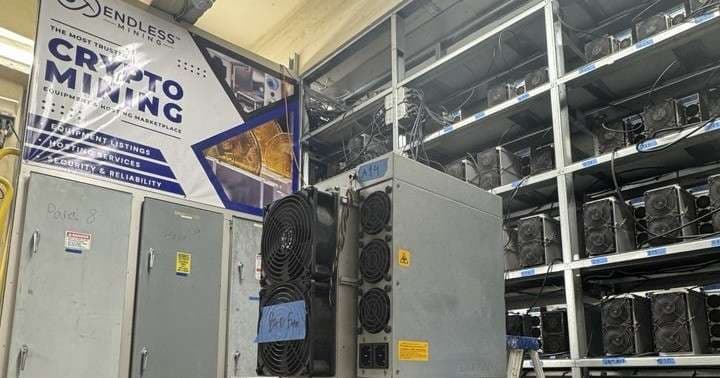
I've been in this industry full-time since 2019. I left a regular job that year to build out EndlessMining. Here's something most "should I quit my job" articles get wrong from the very first sentence: I didn't quit to be a miner. I quit to build a company that sells to miners and hosts their machines for them. We've also operated our own small mining site in Philadelphia for over two years, running roughly 200 units, so when I talk about the operational side of this business, it's not theoretical. That difference matters, and it's basically the whole point of this post.
If you've been watching YouTube videos about plugging in an Antminer in your garage and earning passive Bitcoin, I'm going to save you a lot of money and a lot of time. If you're reading this because the spreadsheet is starting to add up and you're seriously trying to figure out whether mining can replace your salary, keep going. The numbers below are real. The failure modes are real. And the bar is higher than most people think.
What "becoming a Bitcoin miner" actually means: 3 paths
Before any math is useful, you have to pick a path. There are three ways to mine Bitcoin, and they look nothing alike.
The first is home mining. One miner, or a handful, plugged in at your house or a small workshop. Power costs are residential rates, usually 12 to 25 cents per kWh in the US. Heat exhaust is your problem. Internet is your problem. Your local utility may or may not love you. This path has the highest learning curve per dollar and the most personal risk. It almost never replaces a salary.
The second is hosted Bitcoin mining. You buy the hardware, but a hosting facility (like ours) operates it for you. You get industrial power rates, professional cooling, around-the-clock monitoring, networking handled, and your apartment doesn't sound like a jet engine. You pay a per-kWh hosting rate plus setup and a security deposit. Your machines sit in a real data center alongside thousands of others. This is the path that most realistically scales to "this could replace my income."
The third is owning a mining facility. You're not a miner anymore, you're an infrastructure operator. You're securing power contracts, building or leasing buildings, managing employees, running an actual industrial business. This is what I do. The upside is real, and the operational difficulty is something people radically underestimate.
The "should I quit my job for Bitcoin mining" question gets answered very differently across these three paths. Most of this post is about the second one, because that's where the realistic math lives.
Is Bitcoin mining profitable in 2026? Real numbers
As I'm writing this in May 2026, here are the inputs that determine whether mining is profitable today:
- Bitcoin price is around $80,000
- Network hashrate is around 950 EH/s, having recently dipped below the 1 ZH/s mark it crossed earlier this year
- Hashprice (gross daily revenue per terahash) is around $0.038, or about $38 per PH per day. Worth knowing: this number was as low as $28 to $30 per PH per day during Q1 2026, some of the lowest readings on record. We're at the high end of a multi-month range right now.
- Block reward is 3.125 BTC. We're in the post-2024-halving epoch, with the next halving expected April 2028.
At our facility, hosting rates right now are 6.7 to 7.3 cents per kWh on the 85% uptime tier, and 7.2 to 7.8 cents on the 95% uptime tier. Setup is $25 per miner, with a 2-month security deposit covering electricity.
For the calculations below, I'm using a flat 7.5 cents per kWh so the math is easy to follow. Plug in your own number to redo this for your situation.
Bitcoin miner profitability table (May 2026)
Here's what a sample of current and recent-generation Bitcoin miners actually earn at that rate:
Machine
Hashrate
Power
Daily revenue
Power cost
Daily profit
Hardware price
Antminer S21 XP
270 TH/s
3,645 W
$10.26
$6.56
$3.70
~$3,452
Antminer S21 Pro
234 TH/s
3,510 W
$8.89
$6.32
$2.57
~$2,513
Antminer S21+
235 TH/s
3,877 W
$8.93
$6.98
$1.95
~$2,157
Antminer S21 (base)
200 TH/s
3,500 W
$7.60
$6.30
$1.30
~$1,656
Antminer S19 XP
141 TH/s
3,010 W
$5.36
$5.42
-$0.06
~$640
Antminer S19j Pro
100 TH/s
2,950 W
$3.80
$5.31
-$1.51
~$200
Notice what's happening at the bottom of that table. The S19 generation is dead at 7.5 cents. Even an S19 XP at $640 or an S19j Pro at $200 can't cover its own power bill at hosted rates. This is a critical lesson. The cheap used hardware all over Facebook Marketplace is cheap for a reason. The price tag isn't the whole cost. If you can get power under 4 cents per kWh, S19s can still earn. Above 5 cents, they're paperweights that cost you money to plug in.
The sweet spot of the used Bitcoin miner market right now is the S21 base and S21+ generation. They're priced 50 to 70 percent below their original launch prices, and they still produce real margin at hosted rates. This is the buying window most people don't realize they're in.
The AI factor: why hashprice recovered in 2026
There's a story behind the recent hashprice recovery that almost no beginner content covers, and it's the single biggest industry shift of 2026.
A meaningful chunk of Bitcoin mining capacity has been getting sold or repurposed for AI data center use. Operators with good power contracts and the right facility specs can sometimes earn more hosting GPUs for AI workloads than they can mining Bitcoin, and a wave of capacity has migrated. Network hashrate growth slowed and then briefly reversed. We've now had multiple consecutive negative difficulty adjustments in 2026, which is highly unusual.
What this means for someone weighing "should I quit my job for Bitcoin mining":
The short-term economics for surviving Bitcoin miners have improved, because each remaining machine claims a bigger share of the same daily Bitcoin issuance. That's why hashprice has recovered from Q1 lows.
The long-term picture is still that the network grows. CoinShares and other industry trackers project hashrate could rebuild to 1.8 ZH/s by year-end 2026 as new hardware deployments come online. Difficulty has gone up over Bitcoin's history and almost certainly will again. But the path is no longer a smooth one-way climb.
For new entrants, the practical takeaway is: you're entering during a window of slightly improved economics for survivors, but the AI displacement story has not finished playing out. Build your math with conservative assumptions. Don't assume current hashprice is the floor.
Should I quit my job for Bitcoin mining? The salary math
Let's do the math you actually came here for. Say you make $60,000 a year before tax. Day rate equivalent is about $164 a day, every day, weekends included.
To replace that with S21 XPs at $3.70 a day each, you'd need 45 machines. Hardware cost: 45 times $3,452, or about $155,340. Setup is $1,125. The 2-month electricity deposit on 45 machines pulling 3,645 watts each, at 7.5 cents per kWh, comes out to about $17,716. Total upfront, around $174,200.
Now do it with used S21 base units at $1.30 a day each. You'd need 127 machines. Hardware cost: 127 times $1,656, or about $210,312. Setup is $3,175. Deposit comes out to about $48,006. Total upfront, around $261,500.
That's a counterintuitive result. The "cheap" used path actually costs more capital because the lower efficiency means more deposit and more units to manage. This is why efficiency wins long-term, even when new machines look more expensive on the sticker.
To replace a $100,000 salary, multiply everything by about 1.7. To replace a $40,000 salary, multiply by about 0.7. The point isn't the exact number. The point is that realistically replacing a middle-class US salary with Bitcoin mining requires somewhere between $120,000 and $300,000 in upfront capital, depending on what hardware you buy and what kind of life you want to support.
That capital is also at risk. Hashprice fluctuates between roughly $28 and $40 per PH per day depending on the cycle. Difficulty has trended up over Bitcoin's history, even when it dips for stretches like 2026's AI exodus. Your $3.70 a day machine today might be a $2.50 a day machine in 12 months even if Bitcoin's price doesn't move at all.
The tax reality: what your "$3.70 a day" actually becomes
Here's the part of the math beginners almost always miss, and it's painful.
In the US, Bitcoin mining income is taxed as self-employment income. That means you pay regular federal income tax on it, plus state income tax where applicable, plus 15.3% in self-employment tax (Social Security and Medicare combined). You're paying both the employee and employer side because you're a sole proprietor.
Mining payouts are also taxed as ordinary income at the moment you receive them, valued at the BTC price at that moment. If you later sell the BTC for a different price, that's a separate capital gains event on top.
For a quick rule of thumb: a self-employed miner in a typical US tax bracket should mentally treat about 30 to 40 percent of mining gross profit as going to taxes. Your $3.70 a day machine is closer to a $2.30 to $2.60 a day machine after you square up with the IRS. Run your "replace my salary" math at that adjusted number, not the gross.
This is also why most serious miners run the operation through an LLC or S-corp, which can change the tax treatment significantly. Talk to a CPA who has Bitcoin clients before you scale. Don't take tax advice from a blog post. Including this one.
The hidden killer: heat, fire, and the dangers of home Bitcoin mining
I want to tell you about a client of ours.
He bought six miners from us. He set them up in a part of his home. He believed the area had enough ventilation to handle the heat. The miners ran for a while. And then one day the heat exhaust system couldn't keep up, something failed, and the entire section of the house burned down.
Six miners. Not sixty. Not six hundred. Six.
This was devastating to watch as someone who supplied the equipment. It's also the single biggest reason we now push almost everyone toward hosted mining first.
A modern Bitcoin ASIC produces roughly 11,000 to 14,000 BTU per hour of heat. That's the output of a small space heater running at full blast continuously, with no thermostat. Six of them is the equivalent of running six space heaters around the clock in a room that wasn't designed for it. If your exhaust path fails (a fan dies, a duct collapses, a filter clogs) temperatures climb fast. Electronics burn. Plastics catch.
Industrial mining facilities exist for a reason. Negative-pressure airflow design, fire suppression, redundant cooling, around-the-clock monitoring, electrical infrastructure rated for the continuous load. None of that is in your basement. None of it is in your garage. None of it is in your spare bedroom.
If you're going to home-mine, please at minimum run a dedicated electrical circuit with a licensed electrician. Install heat detection and a hardwired smoke alarm in the room. Build proper exhaust ducting with redundancy, meaning more than one fan in a path that doesn't depend on any single point of failure. Consider a fire suppression system if you have more than one or two machines. And verify that your homeowner's insurance covers it. Most policies don't. Read the fine print on "business activity" exclusions.
If any of that sounds like more work than you want to take on, that's the answer to whether you should home-mine. Host instead.
What success actually looks like
I've spent a lot of this post on warnings, so let me balance it with what works.
We have clients who started with three or four machines, treated it as a serious side project for a few years, and now run fleets of 50 to 100+ miners. The strongest of them are netting six figures of mining margin annually while still working their day jobs. Some of them have gone on to quit. Some have decided the side income is more valuable as a side income, because the day job carries health insurance and 401(k) match they don't want to give up.
What those clients have in common: they bought efficient hardware (S21 generation), they hosted instead of home-mining, they reinvested aggressively in their first 18 months, they kept dollar-denominated runway, and they didn't panic-sell during Q1 2026 when hashprice was at $28. They held through the AI displacement scare and came out the other side with stronger margins.
The path is real. It's just a path, not a shortcut.
Why ultra-cheap Bitcoin mining electricity is usually a trap
Newcomers to mining develop a fixation on finding the cheapest possible kWh rate. They see hosting deals advertised at 5 cents, 4 cents, sometimes even lower. They DM me asking why our rates aren't competitive with that.
Here's what I tell them: the cheaper the advertised rate, the higher the probability you're getting scammed, ghosted, or shut down.
Bitcoin mining hosting at industrial scale has a real cost floor. There's the power itself, which has a market price, the same as it does for any industrial buyer. There's the building, the cooling, the personnel (more on this in a second), the networking, the security, and a margin to keep the business solvent. When someone advertises significantly below what those costs add up to, one of a few things is true.
They're cutting corners somewhere that will eventually catch up to them. Usually maintenance or staffing, which means your machines will be down a lot.
Or they're operating under power contracts or in a jurisdiction that isn't sustainable, and they'll get shut down or renegotiated within months.
Or they're outright not running the operation they claim to be running. You'll send them miners, you'll get a few weeks of payouts, then communication will degrade, and you'll never see your hardware again.
The rule of thumb I give people: if a hosting deal is more than about 30 percent below market rates for your region, treat it as suspect until proven otherwise. Ask for references from current clients you can call. Ask to physically visit the facility. Ask for an uptime SLA in writing.
This is also why we offer two tiers: 85% uptime at the cheaper rate, and 95% uptime at the slightly higher rate. The cheaper rate isn't a trick. It reflects the reality that achieving high uptime costs more in staffing and infrastructure. Cutting that corner means missed hash, and missed hash is missed revenue.
The labor reality: 1 person per 5 MW of mining capacity
Here's a number from inside the industry that almost never makes it into beginner content. Per 5 MW of mining capacity, you need 1 full-time experienced employee at a minimum, or 2 if you want uptimes near 100%.
5 MW is roughly 1,300 to 1,400 modern miners. If you only own a handful of machines, this number doesn't apply to you directly because you're paying your hosting facility's share of that headcount through your hosting rate. But if you're modeling out what your own facility might look like, this is the number you build everything around.
What does that employee actually do all day? Replace failed power supplies. Reseat hash boards. Monitor pool stats. Walk rows looking for hot spots. Update firmware. Coordinate with utilities. Diagnose networking issues. Hash boards die at a steady, predictable rate, somewhere around 2 to 4 percent per year, and every one of them is hours of physical work.
This is not passive income. It's a real industrial operation where the difference between mediocre and excellent is human attention.
How to handle Bitcoin price volatility as a miner
Don't.
The mindset that survives long-term in this industry isn't "I'll mine when price is high and turn off when price is low." That's a losing strategy. By the time you've reacted to a price move, the difficulty adjustment has already moved against you. The mindset that survives is simple. As long as my machines are profitable above electricity, I keep mining. Even on break-even days. Even on slightly-below-break-even days, if I have runway.
Why? Because the difficulty adjustment is a self-correcting mechanism. When prices crash and weak miners shut off, network hashrate drops, difficulty adjusts down at the next epoch (every two weeks or so), and the survivors get a bigger share of the same daily Bitcoin issuance. We've watched this play out in real time during 2026's AI displacement. The miners who panic-sold their machines or dumped their BTC at the Q1 bottom are the ones who funded the upside for the disciplined operators who held through.
Practically, that mindset comes down to a few habits.
Keep operating cash in fiat or stablecoins, not just BTC. Industry analyses consistently flag this as one of the biggest cash management lessons from previous cycles. Your power bill is denominated in dollars. Your hosting fees are denominated in dollars. Your runway needs to be in dollars too.
Maintain at least 6 to 12 months of operating runway in non-Bitcoin cash before you commit to mining as your only income. More if you're early in your halving cycle.
Don't lever up against your BTC. Loans collateralized by your mined Bitcoin look attractive in bull markets and become margin-call death traps in bear markets. The miners who blew up in 2022 mostly blew up here.
Modernize ruthlessly. The miners that survived past halvings are the ones who didn't get sentimentally attached to old hardware. When a generation of machines stops being profitable at your power cost, sell or replace.
The S19 generation in our table above is your living lesson on this. Three years ago, those were the best miners on earth. Today they're paperweights at most hosting rates. That's mining.
When is the right time to quit my job for Bitcoin mining?
Here's my honest framework. Three conditions, all of which need to be true.
First, the operation has gotten too large to manage as a side project. If you're losing sleep, missing your day job's deliverables, or letting the mining operation suffer because of the day job, that's a real signal. This usually shows up around the 30 to 50 machine mark for someone managing their own logistics and tax filings, even with hosted hardware.
Second, the mining income materially exceeds your salary. I'll give you the aggressive version and the conservative version.
The aggressive version, which is what some industry people will tell you, is when mining nets you about 10 times your salary. So if you make $60,000, mining is producing $600,000 a year before you quit.
The conservative version, which is what I tell people, is when mining nets you 2 to 3 times your salary on a trailing 12-month basis (after the 30 to 40 percent tax haircut), AND you have the runway and risk tolerance for income to drop 40 to 60 percent in a bad year.
The aggressive version exists because mining income is volatile, taxable in painful ways, and reinvestment-hungry. You don't get to keep all of it. The conservative version is honest about how variable this income actually is.
Third, you have at least 12 months of fiat operating runway. Not Bitcoin runway. Fiat. If your machines went offline tomorrow and you sold zero BTC, could you cover all of life and business expenses for a full year? If not, don't quit yet.
If all three are true, the leap is reasonable. If only one or two are true, you're not ready. The cost of being wrong is being forced to sell hardware and BTC at exactly the wrong moment in the cycle.
The hybrid path: mining as a side business first
The smartest move I've seen from clients who eventually went full-time wasn't quitting their day job. It was running mining as a serious side business for 18 to 36 months first.
Hosting makes this not just possible but easy. You don't have to be physically present. You don't have to know how to swap a hash board. You buy hardware, you ship it to the facility, you watch the dashboard, and you collect your monthly statements. The biggest decisions you're making are when to upgrade and when to take BTC profits.
That window, where you're still drawing a salary, still building 401(k) match, still on your employer's health insurance, while also running a real Bitcoin mining operation, is when you build the muscles you need.
You experience your first difficulty hike with skin in the game. You experience your first miner failure and the warranty claim process. You experience a slow news cycle where hashprice grinds sideways for two months. You experience a real BTC drawdown without panicking. You file mining income on your taxes for the first time and discover what self-employment tax actually feels like. You scale from 5 to 50 machines, learning where the operational pain points actually are.
By the time you're considering quitting, you're not making a leap of faith. You're scaling something you already know works, in conditions you've already lived through.
The honest closing
Bitcoin mining is a real business. It is not passive income. It is not a get-rich-quick play. It is not a way around having a job. It's a different kind of job, one with industrial-scale capital requirements, real operational complexity, real safety risks, and real cyclical pain.
It's also a real business that real people make real money in, year after year, halving after halving. The ones who succeed share a few traits. They treat their power cost as the only number that matters. They keep modernizing their fleet. They hold operating runway in fiat. They don't get emotionally attached to their hardware. And they don't panic-sell at the bottom.
If you're disciplined enough to do all of that while still working a day job, you're disciplined enough to eventually quit it. If you're not, the day job is actually doing you a favor. It's the runway that lets you survive the cycles.
The question isn't really "should I quit my job to become a Bitcoin miner." The question is: am I building an operation strong enough that the day job becomes the part I can afford to lose?
Build that operation first. The quitting takes care of itself.
Frequently Asked Questions
Is Bitcoin mining profitable in 2026?
Yes, for current-generation hardware at competitive electricity rates. At 7.5 cents per kWh hosted, an Antminer S21 XP nets about $3.70 per day in May 2026 before taxes. Older S19-generation machines lose money at the same rate. Profitability depends on three variables: machine efficiency (joules per terahash), electricity cost, and the current Bitcoin hashprice (which ranged from $28 to $40 per PH per day across early 2026).
How much does it cost to start Bitcoin mining as a full-time income?
To replace a $60,000 US salary with hosted Bitcoin mining at 7.5 cents per kWh, you need roughly $174,000 to $261,000 upfront, depending on whether you buy new or used hardware. Replacing a $100,000 salary requires about 1.7 times that amount. This includes hardware, setup fees, and a 2-month electricity deposit, but does not include 12 months of personal living expenses you should have set aside before quitting, and it does not account for the 30 to 40 percent tax haircut on mining gross profit.
Can you mine Bitcoin at home and make a living?
Almost never. Residential electricity rates of 12 to 25 cents per kWh make most modern miners unprofitable, and home setups create real fire and electrical hazards. We had a client whose house caught fire from just six miners running in his home. Hosted mining at industrial rates is the realistic path for replacing income.
What is the best Bitcoin miner to buy in 2026?
For hosted mining at 7 to 8 cents per kWh, the Antminer S21 XP and S21 Pro offer the best balance of efficiency and price. The used S21 base is the best value play, priced around $1,656 with about $1.30 per day net profit before taxes. Avoid the S19 generation unless you have power under 4 cents per kWh.
When should I quit my job to mine Bitcoin?
When three conditions are met: your mining operation is too large to manage as a side project (typically 30 to 50 hosted machines), your mining income is at least 2 to 3 times your salary on a trailing 12-month basis after taxes (some industry people prefer 10 times), and you have 12 months of fiat operating runway separate from your Bitcoin holdings.
Is hosted Bitcoin mining safe?
Hosted mining at a reputable facility is significantly safer than home mining for both fire risk and financial risk. The biggest danger in hosted mining is choosing a facility that advertises rates below the real market floor, which usually indicates a scam, an unsustainable operation, or one with poor uptime. Visit before you ship. Get an SLA in writing. Talk to current clients.
How is Bitcoin mining income taxed in the US?
Mining payouts are taxed as ordinary self-employment income at fair market value when received. That means regular federal and state income tax plus 15.3% self-employment tax (Social Security and Medicare). If you later sell the BTC for a different price, that's a separate capital gains event. Most serious miners operate through an LLC or S-corp to optimize this. Talk to a CPA with Bitcoin experience before scaling.
If you want to talk through your specific situation, what hardware makes sense for your capital, what hosting tier fits your risk tolerance, or just whether the numbers work for you, reach out at agustin@endlessmining.com. We've helped hundreds of people go from "thinking about it" to "running it." We've also told plenty of people honestly that this isn't the right move for them right now. Either answer is fair. Book a call with me here