Turning Heat Into Hashrate: How Bitcoin Mining Is Quietly Rewriting the Energy Playbook
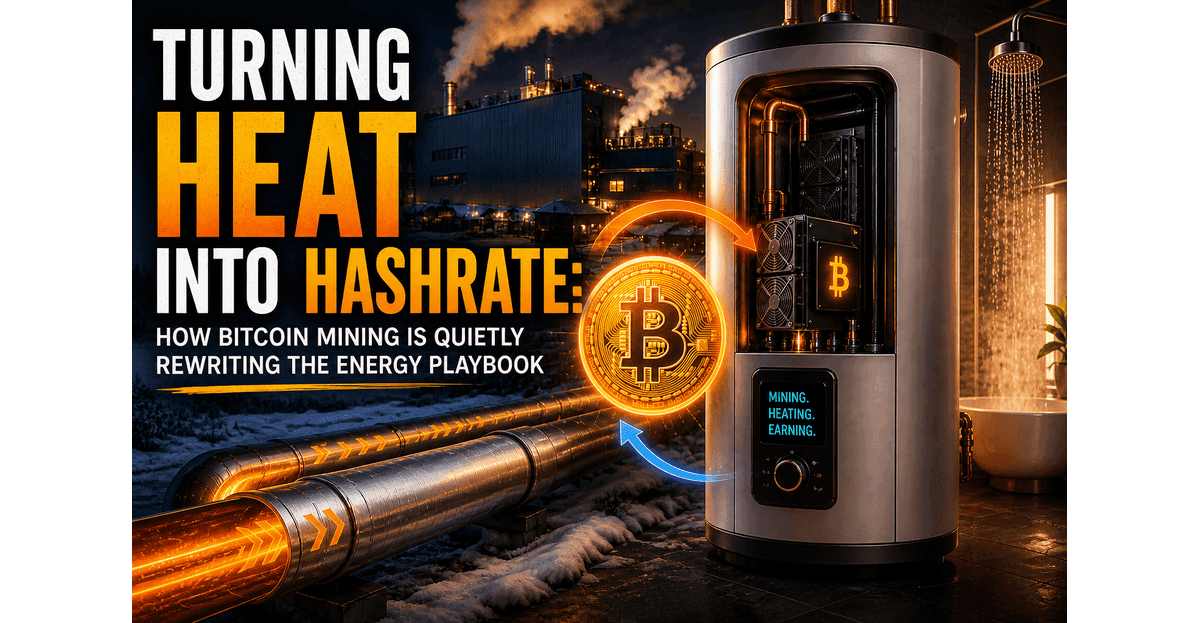
Bitcoin mining has long been criticized for its energy consumption, but a growing wave of real-world deployments is reframing the conversation. Instead of treating mining heat as waste, companies and innovators are beginning to monetize it as a valuable byproduct. What was once seen purely as excess energy is now being integrated into heating systems at both industrial and residential levels, creating a dual-output model where electricity produces both Bitcoin and usable heat.
In Finland, this concept is already operating at scale. Mining facilities are being connected directly into district heating networks, where water used to cool ASICs exits at temperatures between roughly 50 to 78 degrees Celsius before being circulated through municipal pipelines. These systems are now helping heat tens of thousands of homes, with some estimates suggesting coverage reaching well over 80,000 residents and continuing to expand. The model is simple but powerful: instead of wasting heat through ventilation, it is captured, transported, and sold as a resource.
The impact goes beyond just efficiency. Nearly all electricity consumed by mining is ultimately converted into heat, meaning the process inherently produces a constant and predictable thermal output. When captured, this heat can replace traditional heating sources like oil, gas, or biomass, reducing emissions and lowering operational costs for district energy systems. In colder climates especially, this creates a natural alignment between mining operations and year-round heating demand.
What makes this model particularly compelling is its speed and scalability. Integrating mining into existing heating infrastructure can be done relatively quickly compared to building new power plants or retrofitting entire energy systems. This allows cities and operators to deploy flexible heating capacity that can also act as a controllable load on the grid, ramping up or down based on energy availability.
At the residential level, the same idea is beginning to take shape in consumer hardware. New devices are embedding ASIC miners directly into household systems like water heaters. Rather than using traditional electric heating elements, these systems rely on mining activity to generate heat, effectively turning a standard utility expense into a potential revenue stream. Some models suggest they can offset a meaningful portion of electricity costs while generating Bitcoin in the background, blending infrastructure with computation in a way that has not been widely seen before.
This approach introduces a new category of �productive appliances� where energy use is no longer a sunk cost. A water heater, space heater, or similar device can simultaneously perform its primary function while participating in the Bitcoin network. In theory, this pushes mining further toward decentralization by distributing hashrate across homes and buildings instead of concentrating it in large-scale facilities.
There are, however, real trade-offs. Bitcoin mining remains energy-intensive, and its economics are tightly tied to electricity prices and network difficulty. If power costs are high or mining rewards decline, the financial upside can narrow significantly. Hardware lifespan is another factor, as mining equipment tends to become obsolete faster than traditional home appliances. There is also the broader question of energy sourcing, since the environmental benefits depend heavily on whether the electricity used is renewable or fossil-based.
Even with these challenges, the direction is clear. The industry is moving toward a model where energy efficiency is not just about reducing consumption, but about extracting maximum value from every watt used. Bitcoin mining, by design, produces a steady stream of heat, and the ability to capture and repurpose that heat is turning a long-standing criticism into a potential advantage.
For mining companies, this creates new opportunities to partner with energy providers and municipalities. For homeowners, it opens the door to offsetting everyday utility costs with embedded compute. And for the broader energy landscape, it signals a shift toward systems where digital and physical infrastructure are increasingly intertwined.
Bitcoin mining is no longer just about securing the network. It is becoming part of a larger conversation about how energy is produced, used, and reused in a more efficient and integrated way.