The Ultimate Iceriver ASIC Miners Review: All Iceriver Miners Compared (2026)
This Iceriver ASIC miners review breaks down every KS, AE, AL, and RX model for 2026 profitability, noise, and specs. Find your best fit fast.
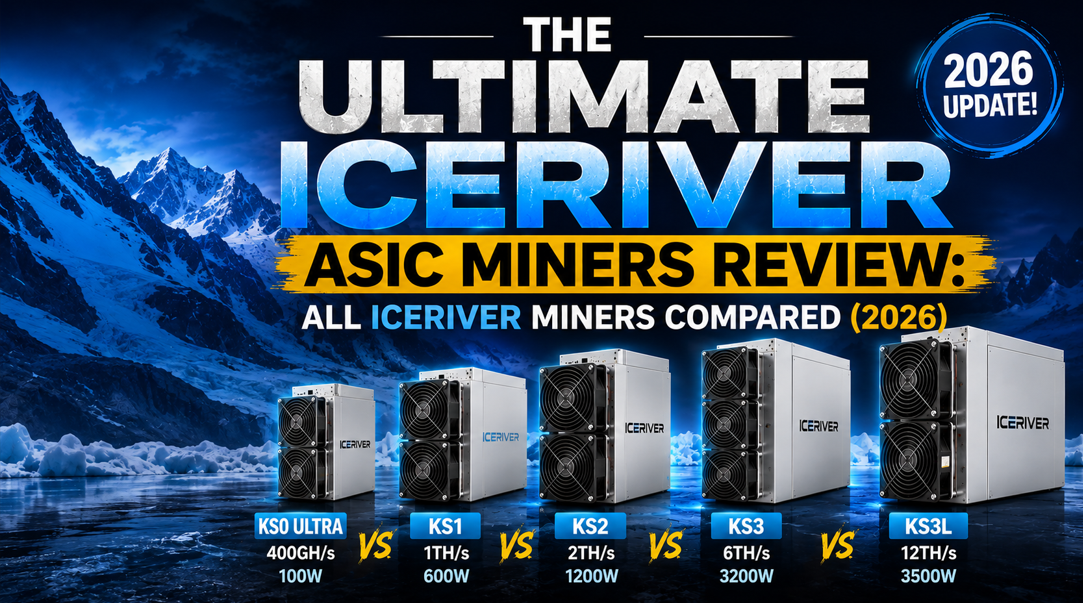
TL;DR: Iceriver ASIC Miners Review in 10 Bullets
- Iceriver dominates three altcoin ASIC categories: KHeavyHash (Kaspa), zk-SNARK (Aleo), and Blake3 (Alephium).
- The KS0 Ultra is the best home miner in the whole lineup: 400 GH/s, only 100W, and it's quiet enough for a bedroom.
- Kaspa mining is brutal right now — roughly 87% of KAS miners run at a loss at $0.07/kWh as of early 2026.
- Aleo mining with the AE-series looks more promising thanks to a smaller, less saturated miner pool.
- The AE3 (2 GH/s) is a beast, but it eats 3,400W and only makes sense for big operations.
- Noise levels across Iceriver's spec sheets are wildly inconsistent between retailers — we flag where the numbers don't add up.
- Alephium's AL-series is a sneaky pick for folks who want a lower-competition altcoin with legit hardware support.
- Nobody else has published a single article that compares all four Iceriver product families side by side. This one does.
- US buyers should budget for landed cost, not just sticker price — duties and freight can add 10-20% on top.
- Bottom line: Iceriver wins on variety and home-friendly options, but you've got to pick your algorithm wisely in 2026.
The goal here isn't to hype every model. It's to give you an honest read so you spend your money on the right machine, not just the flashiest one.
Iceriver ASIC Miners Review: Who Is Iceriver Anyway?
Iceriver isn't some fly-by-night miner brand. They basically built the Kaspa ASIC market from scratch. When Kaspa's KHeavyHash algorithm made the jump from GPU-friendly to ASIC-friendly territory, Iceriver was first in line with purpose-built hardware. That head start paid off, and the KS series became the go-to for anyone serious about Kaspa mining.
Since then, the company hasn't sat still. They expanded into Aleo mining with the AE series, jumped into Alephium with the AL series, and even dipped into Radiant with the RX0. That's a broader spread of algorithms than almost any competitor outside of Bitmain and Goldshell.
What makes Iceriver stand out, though, isn't just being first. It's the range. You can grab a 100W home unit that runs quiet enough to sit next to your desk, or you can go all-in on a 3,500W industrial rig for a full-blown farm. Not many brands cover both ends of that spectrum this well.
That said, "first to market" and "best in class" aren't always the same thing. Let's get into the actual product lines and see where Iceriver earns its reputation and where it doesn't.
Iceriver ASIC Miners Review by Product Line
KS Series (Kaspa Mining)
The KS series is where Iceriver made its name, and it's still the biggest lineup they sell. On the entry end, you've got the KS0 and KS0 Pro, both built for beginners dipping a toe into Kaspa. Then the KS0 Ultra steps things up with 400 GH/s at just 100W, which is honestly a great efficiency number for a home unit.
Moving up, the KS1 and KS2 sit in that comfortable middle ground — solid hashrate, still manageable power draw. Once you hit the KS3, KS3L, and KS3M, you're in serious farm territory. And at the very top, the KS5L, KS5M, and KS7 push past 30 TH/s, which is where the big Kaspa operations live.
Here's the catch, though: Kaspa's network difficulty has climbed a ton, so even the flagship KS7 barely scrapes by on standard electricity rates. We'll dig into the numbers in the profitability section below.
AE Series (Aleo Mining)
Aleo mining is still a newer game, and Iceriver is one of only two manufacturers making dedicated Aleo ASICs (Goldshell being the other). That's a small club, which honestly works in Iceriver's favor since competition is thinner.
The lineup runs from the AE0 (50-60 MH/s, 100W) for home use, up through the AE1 Lite (300 MH/s), the AE2 (720 MH/s), and finally the AE3, which comes in two flavors: a 600 MH/s efficient version and a monster 2 GH/s version that pulls 3,400W.
If you're just getting your feet wet with Aleo, the AE0 or AE1 Lite makes way more sense than jumping straight to the AE3. Save the big iron for when you're scaling up.
AL Series (Alephium Mining)
Alephium doesn't get talked about nearly as much as Kaspa, but that's kind of the point. Less hype means less competition on the network, and Iceriver's AL series covers it well. The AL0 kicks things off at 400 GH/s for 100W, making it another solid home pick. From there you move to the AL2 Lite, and eventually the AL3, which hits 15 TH/s but demands 3,500W and runs loud — some listings put it around 75dB, which is vacuum-cleaner territory.
RX Series (Radiant Mining)
The RX0 is Iceriver's lone Radiant miner right now, running the SHA512256d algorithm at 260 GH/s for 100W. It's a niche pick since Radiant doesn't have nearly the following that Kaspa or even Aleo does, but if you're already mining Radiant, it's a legit efficient option worth a look.
Since it's the only Radiant model in Iceriver's whole catalog, there's no upgrade path within the brand. You either commit to it or you look elsewhere, so weigh that before you buy.
Setup, Firmware, and Software Experience
Buying the hardware is only half the battle. Setup matters too, and this is where Iceriver generally does well. Most units connect over Ethernet and show up on your network dashboard within minutes. The web-based interface lets you check hashrate, temps, and fan speed without digging through command-line tools.
Firmware updates roll out periodically, and they're usually straightforward to install. That said, we'd still recommend double-checking your pool configuration after any update, since a botched firmware flash is one of the more common headaches miners run into with any ASIC brand, not just Iceriver.
Pool compatibility is solid across the board. Standard Kaspa, Aleo, and Alephium pools all play nicely with Iceriver hardware, including F2Pool, HeroMiners, WoolyPooly, and 2Miners. So you're not locked into anything proprietary.
Resale Value and Long-Term Ownership
Nobody talks about this enough, but resale value matters just as much as day-one profitability. ASIC hardware depreciates fast, especially once a newer, more efficient model drops. Iceriver's home units (KS0 Ultra, AE0, AL0) tend to hold value better than the industrial tiers, mostly because low power draw and low noise stay relevant even as network difficulty climbs.
Industrial units depreciate faster. Once network difficulty outpaces a model's efficiency, resale demand drops off a cliff since nobody wants a power-hungry machine that barely breaks even. If you're buying with resale in mind, lean toward the smaller, more efficient models rather than the flagship industrial units.
Warranty coverage plays into this too. New Iceriver hardware typically carries a manufacturer warranty around 180 days, though this varies by reseller. Always confirm the warranty terms before buying secondhand, since used units usually carry little to no coverage at all.
Full Iceriver Comparison Table
| Model | Algorithm / Coin | Hashrate | Power | Noise | Best For |
|---|---|---|---|---|---|
| KS0 Ultra | KHeavyHash / KAS | 400 GH/s | 100W | ~40dB | Home miners |
| KS3M | KHeavyHash / KAS | ~7.3 TH/s | 3,200W | ~75dB | Small farms |
| KS7 | KHeavyHash / KAS | 30+ TH/s | ~3,400W | ~75dB | Industrial farms |
| AE0 | zk-SNARK / Aleo | 50-60 MH/s | 100W | ~45dB | Aleo beginners |
| AE1 Lite | zk-SNARK / Aleo | 300 MH/s | 500W | ~45dB | Growing Aleo ops |
| AE3 (2G) | zk-SNARK / Aleo | 2 GH/s | 3,400W | ~45dB | Big Aleo farms |
| AL0 | Blake3 / Alephium | 400 GH/s | 100W | 10-50dB* | Home miners |
| AL2 Lite | Blake3 / Alephium | 2 TH/s | 500W | ~55dB | Mid-tier ops |
| AL3 | Blake3 / Alephium | 15 TH/s | 3,500W | ~75dB | Industrial farms |
| RX0 | SHA512256d / Radiant | 260 GH/s | 100W | ~40dB | Niche home mining |
*Noise numbers for the AL0 vary wildly between retailers (we've seen 10dB, 40dB, and 50dB listed for the exact same unit). Always confirm with the seller before you buy based on noise alone.
Is Iceriver Mining Actually Profitable in 2026?
Let's be real with you here, because most reviews won't. Kaspa mining economics have gotten rough. As of early 2026, KAS has been trading in the $0.03 to $0.05 range, and network difficulty has climbed to multi-year highs. That combo means roughly 87% of Kaspa ASIC miners on the market are operating at a loss when electricity runs around $0.07/kWh.
Even Iceriver's flagship KS7 only nets a small daily profit under those conditions, and the payback period stretches out for years. So if you're eyeing a KS-series miner purely as an investment, run your own numbers first using your actual electricity rate before you pull the trigger.
Aleo tells a different story, though. Since the miner pool is way smaller and only two brands make dedicated hardware, margins tend to hold up better. If profitability matters more to you than brand loyalty, the AE series is worth serious consideration over the KS series right now.
One bright spot for Kaspa long-term: the network's Toccata hard fork landed in mid-2026, adding smart contract functionality and token support. That's a bullish signal for adoption, even if mining margins haven't caught up yet. Worth watching if you're playing the long game.
Electricity Costs and Break-Even Time
Your electricity rate matters more than almost anything else in this equation. At $0.07/kWh, most Kaspa miners struggle. Drop that rate to $0.04/kWh or lower, and suddenly the math looks a lot friendlier, even on older KS-series hardware.
That's why so many serious miners chase cheap industrial power or renewable sources like solar and hydro instead of running off standard residential rates. If you're mining from home and paying retail electricity prices, stick to the low-power home units and treat any profit as a bonus rather than the main goal.
Break-even time also depends heavily on hardware cost. Buying secondhand can cut your break-even window significantly, though you're trading that savings for a shorter remaining lifespan and usually no warranty. Weigh that tradeoff honestly before you buy used just to save a few hundred bucks.
Iceriver Strengths (What They Get Right)
Iceriver earns its reputation in a few clear ways. First, the sheer breadth of their catalog is impressive. Nobody else covers Kaspa, Aleo, Alephium, and Radiant under one roof with this many tiers to choose from.
Second, they nail the home-mining category. The KS0 Ultra, AE0, and AL0 all hit that sweet spot of low power draw, compact size, and low enough noise to actually live in a house or small office. Not every ASIC brand bothers building for home use, but Iceriver clearly does. That's a real differentiator, since plenty of competitors focus exclusively on farm-scale hardware and leave hobbyist miners out in the cold.
Third, build quality holds up. Reviewers consistently mention wide temperature tolerance (many units handle 5°C to 40°C) and dual-fan cooling systems that keep things stable even when conditions aren't perfect.
Finally, being first-to-market on multiple algorithms means Iceriver has years of firmware refinement behind them. That matters more than people realize, since a buggy miner is a useless miner no matter how good the specs look on paper.
Iceriver Weaknesses (Where They Fall Short)
Now for the stuff nobody's talking about. Spec sheets across different retailers frequently contradict each other. We found the exact same AL0 unit listed with noise ratings of 10dB, 40dB, and 50dB depending on the seller. That's not a small gap, and it makes it tough to trust any single listing at face value.
Support and warranty info is also inconsistent. A lot of listings just say "contact the seller" instead of giving a clear, standardized warranty policy straight from Iceriver. Compare that to bigger names like Bitmain, who publish clearer support terms. If customer support matters to you as much as raw specs, factor that gap into your decision.
Then there's the profitability gap we already covered. Iceriver doesn't make this easy to find anywhere in their own marketing, and honestly, neither do most of the reseller sites reviewing their products. Buyers deserve real numbers, not just hashrate bragging rights.
Lastly, the industrial-tier units (KS7, AE3 2G, AL3) run hot, loud, and power-hungry. They're built for farms with proper ventilation and cheap electricity, not casual buyers looking to dip a toe in.
On top of that, resale demand thins out fast for those same industrial units once a newer model launches, so don't treat a farm-tier purchase as a short-term flip. Go in expecting to run it for the long haul, or don't go in at all.
Cooling and Noise Management Tips
If you're setting up anything beyond a home-tier unit, cooling deserves real planning. Industrial models like the KS7 or AL3 push serious heat, and cramming one into a closet without airflow is a fast way to shorten its lifespan.
A few practical tips: keep ambient temps within the manufacturer's rated range (usually 5°C to 40°C), give the unit at least a few inches of clearance on all sides, and consider a dedicated exhaust fan if you're running multiple units in one room. For home units, a simple desk fan pointed at the intake is usually plenty.
Noise matters just as much as heat. If a listing's noise rating seems too good to be true, it probably is, so plan for the louder end of any range you see until you can verify it yourself.
Iceriver vs Goldshell vs Bitmain: How It Stacks Up
So how does Iceriver actually compare to the big names? Against Goldshell, it's close. Both brands make Aleo ASICs, and both offer compact home units. Goldshell's KA Box Pro competes directly with Iceriver's KS-series on Kaspa, though Iceriver generally edges out on efficiency for entry-level units.
Against Bitmain, it's a different fight entirely. Bitmain's Antminer KS7 currently holds the title of most profitable Kaspa miner on the market, technically beating Iceriver's own KS7 on raw returns. However, Bitmain doesn't touch Aleo or Alephium at all, so if you want algorithm diversity, Iceriver is still your best bet.
The takeaway: if Kaspa profitability is your only goal, Bitmain wins. If you want flexibility across multiple altcoins plus solid home-mining options, Iceriver comes out ahead.
| Brand | Algorithms Covered | Home-Friendly Units | Kaspa Profitability |
|---|---|---|---|
| Iceriver | Kaspa, Aleo, Alephium, Radiant | Yes, multiple | Moderate |
| Goldshell | Kaspa, Aleo | Yes, limited | Moderate |
| Bitmain | Kaspa | No | Strongest |
That table sums it up pretty well. Nobody beats Iceriver on variety, but if raw Kaspa returns are all you care about, Bitmain still takes the crown for now.
Landed Cost: What Iceriver Miners Actually Cost After Import
Here's something almost nobody covers in these reviews, and it matters a ton if you're buying into the US or elsewhere outside China. The sticker price on a marketplace listing is never the full story. You've got freight, customs duties, and possibly brokerage fees stacked on top.
Import duty rates on mining hardware have shifted a lot recently thanks to changes in US tariff policy, so don't assume last year's numbers still apply. Depending on your shipping route and current rates, you could be looking at anywhere from 10% to 20% added onto the base price by the time your miner clears customs and lands at your door.
Bottom line: always budget for landed cost, not just the number on the product page, before you commit to a purchase.
It also pays to compare shipping origins. Some resellers ship from China, others from Hong Kong, and transit times plus duty treatment can differ between the two. A slightly higher sticker price from a closer warehouse sometimes beats a cheaper listing that takes weeks and adds surprise fees at the border.
Which Iceriver Miner Should You Buy?
If you're brand new to mining and just want to test the waters, go with a home-tier unit: the KS0 Ultra, AE0, or AL0. Low power, low noise, low commitment.
If you're scaling up a small operation and want a coin with less competition, the AE-series (Aleo) is your best bet for 2026 given current profitability trends. Skip straight past the KS-series unless you're getting rock-bottom electricity rates.
If you're running an actual farm with cheap power and proper cooling, the industrial tiers (KS7, AE3, AL3) make sense, but only after you've run your own ROI math with current difficulty and coin prices.
And if you're torn between two algorithms entirely, don't just pick based on hype. Pull up a mining calculator, plug in your actual electricity rate, and compare projected daily profit across the KS, AE, and AL lines before you spend a dollar. Five minutes of math can save you months of regret.
Common Mistakes First-Time Iceriver Buyers Make
Even smart buyers trip up on a few predictable things. First, people buy based on hashrate alone and ignore power draw entirely. A miner with a huge hashrate but terrible efficiency can actually cost more to run than it earns, especially once you factor in your real electricity rate.
Second, buyers skip the noise check. That AL0 listing showing 10dB sounds amazing until you realize it's probably a typo or a best-case lab number, not real-world performance. Always plan for the higher end of any noise range you see.
Third, a lot of first-timers forget about landed cost entirely and get blindsided by duties and fees once the package clears customs. Budget for it upfront instead of getting surprised later.
Finally, some buyers jump straight to an industrial-tier unit because it looks like the "best" option on paper. Unless you've already got cheap power and proper ventilation sorted out, a home-tier unit is almost always the smarter starting point. You can always scale up once you know what you're doing.
Iceriver ASIC Miners Review FAQ
Is Iceriver a legit ASIC miner brand?
Yes. Iceriver has a solid track record and was actually first to market with dedicated Kaspa ASIC hardware. They've since expanded into Aleo, Alephium, and Radiant mining, building a reputation for reliable, well-built machines.
Which Iceriver miner is best for beginners?
The KS0 Ultra is the easiest entry point if you want to mine Kaspa. It only draws 100W, runs quietly, and won't break the bank. If you're leaning toward Aleo instead, the AE0 is the beginner-friendly equivalent.
Is Kaspa mining still profitable in 2026?
It's tough right now. With KAS trading in the $0.03-$0.05 range and network difficulty near record highs, most Kaspa miners struggle to turn a profit at standard electricity rates. Cheap power changes the math significantly, so run your own numbers first.
How loud are Iceriver miners?
It depends heavily on the model. Home units like the KS0 Ultra and AL0 typically run around 40-50dB, which is manageable indoors. Industrial units like the KS7 or AL3 can hit 75dB or more, which is genuinely loud and needs a dedicated space.
What's the difference between Iceriver's KS, AE, and AL series?
The KS series mines Kaspa using the KHeavyHash algorithm. The AE series mines Aleo using zk-SNARK proofs. The AL series mines Alephium using the Blake3 algorithm. Each series has its own separate hardware since the algorithms aren't interchangeable.
Where can I buy Iceriver miners in the US?
Iceriver miners are available through authorized resellers and marketplaces that carry ASIC mining hardware, including specialized platforms built specifically for buying, selling, and comparing miners.
Do Iceriver miners come with a warranty?
Most new units carry a manufacturer warranty around 180 days, though exact terms vary by reseller. Always confirm coverage directly with the seller before you buy, especially if you're shopping secondhand.
Is Alephium mining better than Kaspa mining right now?
For 2026, Alephium and Aleo both look more favorable than Kaspa on a pure margin basis, mainly because network competition is thinner. Kaspa still has the strongest community and liquidity, so it comes down to whether you're optimizing for margins or for mining the more established coin.
Final Verdict
Iceriver earns its spot as one of the most versatile ASIC brands on the market in 2026. The home-mining lineup is genuinely great, the algorithm variety beats almost everyone except the biggest players, and build quality holds up across the board.
But don't buy on brand reputation alone. Run your own profitability numbers, double-check noise specs before committing, and factor in landed cost if you're importing. Do that homework, and an Iceriver miner can absolutely earn its keep in your setup.
At the end of the day, this Iceriver ASIC miners review boils down to one simple rule: match the hardware to your actual goals, not the flashiest spec sheet. Whether that's a quiet KS0 Ultra humming away in your home office or a full AE-series farm chasing Aleo margins, Iceriver has an option that fits. Just go in with your eyes open, and you'll come out ahead.
Ready to Mine Smarter? Meet EndlessMining.com
If you’re serious about crypto mining, challenges like— trust, accountability, security, and efficiency — are problems you face every day. That’s exactly why EndlessMining.com was built.
EndlessMining.com is the mining hardware marketplace that actually has your back:
🛒 Buy & Sell Mining Hardware — Browse a curated marketplace connecting miners, dealers, and buyers worldwide.
🏠 Hosting Services — Skip the overhead. Let EndlessMining host your miners in professional facilities so you can focus on returns.
💡 Mining Consultancy — Get expert guidance on equipment selection, setup, and optimization from people who live and breathe mining.
🧮 Mining Calculator — Run the numbers before you commit. Estimate profitability based on your hardware, power costs, and current network conditions.
🔒 Escrow-Protected Transactions — EndlessMining.com is currently the only crypto miner marketplace officially partnered with Escrow.com, meaning every transaction is protected. No scams. No chargebacks. No uncertainty. In a space defined by trustlessness, Endlessmining.com offers something rare: accountability you can count on.